
AC EV Charger Power Selection: 7.4 kW vs 11 kW vs 22 kW for European B2B Buyers
Short answer: For most European residential and light-commercial sites, a 3-phase 11 kW AC EV charger is the sweet spot — three times faster than 7.4 kW on a single-phase supply, no grid upgrade in the majority of EU buildings, and AFIR-aligned for public/shared use. Choose 22 kW only when the DNO confirms three-phase headroom and the vehicles actually charge at 22 kW; otherwise you pay for hardware the cars will never draw.
Why AC Power Selection Matters for European Distributors
For European distributors and installers, picking the right AC charger power tier — 7.4 kW, 11 kW, or 22 kW — is the single most consequential sizing decision in a project. It dictates the upstream electrical work, the breaker sizing, the cable cross-section, and whether the end customer will need a Distribution Network Operator (DNO) application. Spec it wrong and the install becomes unprofitable; spec it right and the same SKU family serves 80% of B2B sites.
Across the EU and UK, three constraints drive the decision every time:
- Available grid supply — single-phase 230 V vs three-phase 400 V, and the main fuse rating at the premises.
- Onboard charger acceptance — most EVs cap AC charging at 11 kW or 22 kW regardless of what the wallbox can deliver.
- Use-case dwell time — workplace 8-hour stays reward 11 kW; fleet overnight stays reward 22 kW; hotel 14-hour overnight stays rarely need more than 7.4 kW.
The Three Power Tiers Explained
7.4 kW single-phase — the entry tier
7.4 kW is the natural ceiling on a standard single-phase 230 V, 32 A supply. A 60 kWh EV battery takes roughly 8 hours from 10% to 80%. It is the lowest-cost option, but increasingly rare as a brand-new install in 2026 because three-phase supplies are now standard in most EU residential blocks and most commercial builds.
11 kW three-phase — the European sweet spot
11 kW on three-phase 400 V, 16 A per phase is the modern European default. The same 60 kWh EV finishes in roughly 5.5 hours, well inside any overnight workplace or destination-charging window. Hardware cost is only modestly higher than 7.4 kW, but installation cost is essentially identical because three-phase cabling is already in place.
For B2B buyers stocking one SKU family for mixed residential and small commercial, 11 kW covers the broadest slice of the demand curve.
22 kW three-phase — the high-end tier
22 kW on three-phase 400 V, 32 A per phase cuts the 60 kWh charge to roughly 2.7 hours. The hardware premium is real — bigger internal contactors, thicker cable gland, thermal headroom — and on most sites you also need DNO permission to lift the main fuse above the standard residential rating. Reserve 22 kW for fleet depots, public fast-charge kerb sites, and dedicated EV-dedicated parking bays where dwell time is short.
AC EV Charger Power Tier Comparison
| Specification | 7.4 kW (1-phase) | 11 kW (3-phase) | 22 kW (3-phase) |
|---|---|---|---|
| Supply | 230 V, 1-phase, 32 A | 400 V, 3-phase, 16 A | 400 V, 3-phase, 32 A |
| 60 kWh EV charge time (10 → 80%) | ~8 hours | ~5.5 hours | ~2.7 hours |
| Breaker upstream | 40 A RCBO + Type A RCD | 20 A 3-pole MCB + Type A RCD | 40 A 3-pole MCB + Type A RCD |
| Cable cross-section | 6 mm² | 2.5 mm² | 6 mm² |
| DNO notification typical | Standard | Standard | Often required above 32 A main fuse |
| Best-fit use cases | Existing single-phase retrofit; low-dwell home | Default for new-build EU residential, workplace, hotel | Fleet depot, public kerb fast-charge, EV-only bays |
| Vehicle compatibility note | All Type 2 EVs | All Type 2 EVs (most cap at 11 kW AC) | Only EVs with 22 kW AC onboard charger benefit fully |
Grid Capacity and DNO Considerations
The grid supply is the binding constraint, not the wallbox spec sheet. Before choosing a tier, distributors should walk the installer through these checks:
- Confirm available phases. Many older European buildings, especially in Italy, Spain, and parts of the UK, are still single-phase only. Retrofitting three-phase is expensive and rarely worth it just for an EV charger.
- Read the main fuse rating. If the property has a 63 A or 80 A main fuse, 22 kW is usually fine without DNO work. Below that, expect paperwork.
- Audit existing large loads. Heat pumps, induction cooking, electric water heating, and existing EV chargers all share the same headroom. A dynamic load-balancing system is often cheaper than a grid upgrade.
- Check DNO timelines. In Germany, the Netzbetreiber approval commonly takes 6–10 weeks. In the Netherlands and Belgium it is faster but still non-trivial. Plan procurement to match.
Dynamic Load Balancing Across Multiple Chargers
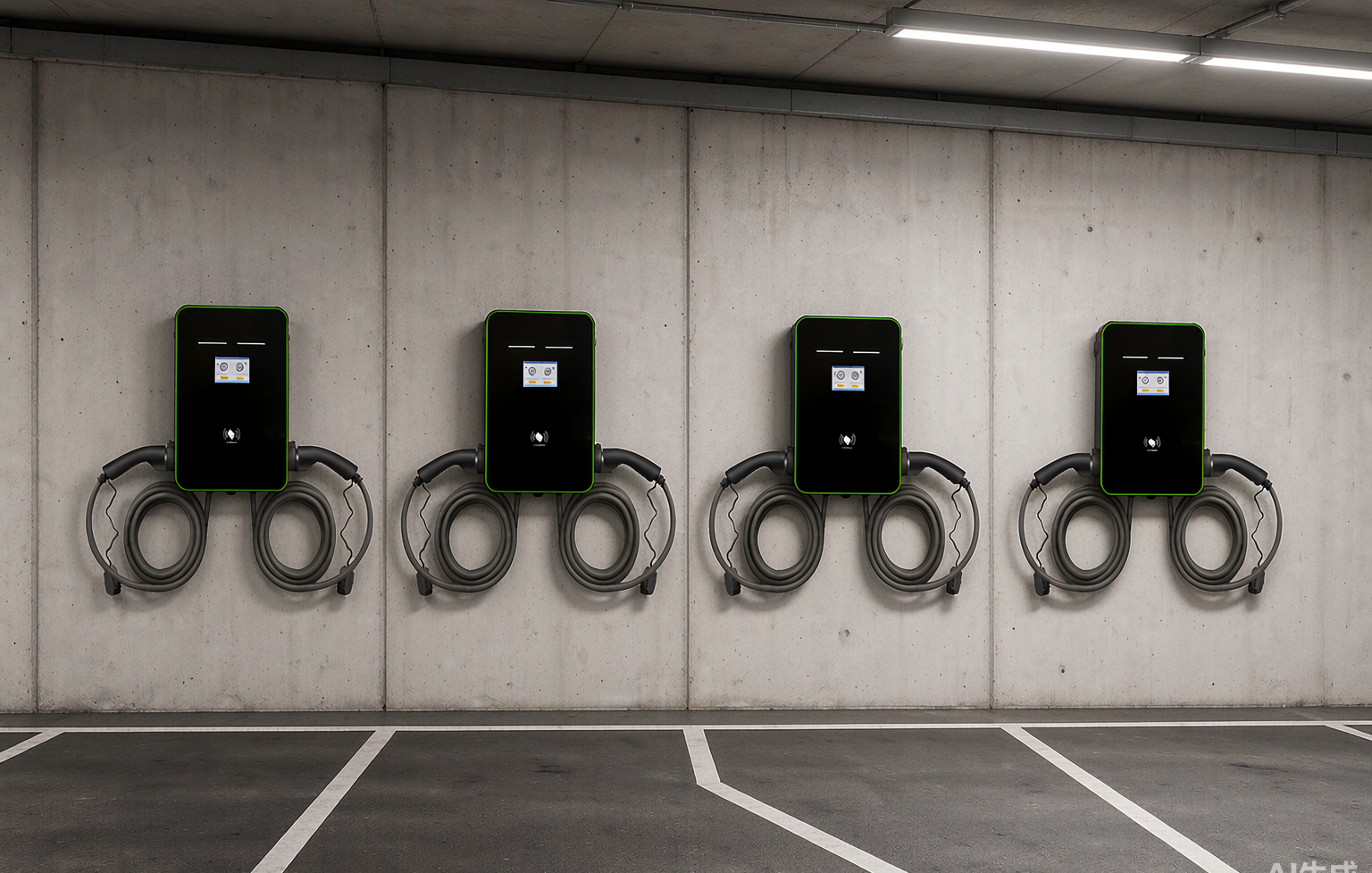
For B2B sites with multiple bays — workplace, apartment block, hotel — installing individual 22 kW chargers is almost always wrong. Each unit at full draw would exceed the site supply. The right pattern is:
- Cluster of 11 kW units with a site-level load-management controller.
- Total cluster sized to fit the available headroom, e.g. 4 × 11 kW on a 63 A three-phase supply.
- OCPP 1.6 / 2.0.1 backend with per-session current limits, so peak demand never exceeds the contracted capacity.
This pattern lets the customer future-proof: start with 2 chargers, expand to 8, never change the grid contract. For European distributors, recommending a load-balancing-ready wallbox family is a clear competitive lever against single-unit brands.
What B2B Buyers Should Specify
When evaluating an AC charger SKU for European distribution, the power tier should always be paired with these technical asks:
- Three-phase 11 kW as the base SKU, with 22 kW as a configurable variant from the same enclosure — same install footprint, same cable routing, same RCD.
- Type A RCD + 6 mA DC fault monitoring per IEC 62955, or Type B RCD if no DC monitoring is integrated. This is mandatory under IEC 61851-1 for AC EV charging.
- OCPP 1.6 JSON minimum, with OCPP 2.0.1 firmware upgrade path to stay aligned with AFIR.
- MID-certified energy meter (or Eichrecht where required) if the unit bills the end user for kWh consumed.
- Integrated PEN fault detection for UK installations, where TN-C-S earthing requires it under BS 7671 Amendment 2.
- IP54 / IK08 enclosure minimum for outdoor commercial parking.
Distributor & Installer Buyer Checklist
- ☐ Confirm the site’s available phases (1 or 3) and main fuse rating before choosing a tier.
- ☐ Decide tier per bay, but size the cluster against total headroom, not per-bay peak.
- ☐ Specify Type A RCD + 6 mA DC monitoring or Type B RCD per IEC 61851-1.
- ☐ Confirm OCPP 1.6 / 2.0.1 backend compatibility with the operator platform.
- ☐ Require MID metering for any session billed to a third party.
- ☐ Confirm dynamic load-balancing support for any multi-bay site.
- ☐ Verify IP54 / IK10 rating for outdoor commercial installs.
- ☐ Confirm CE / UKCA / CB documentation and the matching DoP before shipment.
- ☐ Plan DNO application timeline if 22 kW above a 32 A main fuse is in scope.
- ☐ Stock one SKU family across 7.4 / 11 / 22 kW to simplify spare parts and training.
FAQ — AC EV Charger Power Selection
Can my EV charge at 22 kW if the wallbox supports it?
Only if the vehicle’s onboard AC charger accepts 22 kW. Most mass-market EVs (Tesla Model 3, Hyundai Ioniq 5, VW ID.4, BMW iX1) cap at 11 kW AC. Premium models — Renault Megane E-Tech, certain Porsche, smart #1 — accept 22 kW. If the fleet is mixed, the 22 kW wallbox only delivers value on the subset of cars that can use it.
Do I really need three-phase for 11 kW?
Yes. 11 kW on single-phase would require 47 A continuous draw, far above the 32 A single-phase standard. 11 kW is a three-phase product by definition.
Should I just install 22 kW everywhere to be safe?
No. 22 kW carries higher hardware cost, larger upstream breaker, DNO paperwork, and generates more heat in the enclosure — which shortens component life. Use 22 kW only where dwell time genuinely demands it. For most workplace and destination sites, 11 kW is the right answer.
When is dynamic load balancing mandatory?
Anywhere the total installed charger capacity could exceed the site supply — typically any cluster of 3 or more chargers, or any site with heat pumps or other large flexible loads. It is not always legally mandated, but it is the only reliable way to avoid nuisance trips.
Sourcing AC Chargers From Amprisen
Amprisen ships a unified AC EV charger family covering 7.4 kW, 11 kW, and 22 kW tiers from a single enclosure platform, manufactured at our 10,000 m² facility in Suzhou with 65+ R&D engineers and DEKRA-certified production lines under ISO 9001 and IATF 16949. The same control board supports OCPP 1.6 / 2.0.1, MID metering, Type A RCD with 6 mA DC fault monitoring, and dynamic load balancing across clusters — so European distributors can stock one platform and configure per-site. CE, UKCA, and CB Scheme documentation ships with every order, and the engineering team supports DNO application files on request.
For project sizing, tender documentation, or a tier-by-tier quote, contact the Amprisen European distribution team with the site single-line diagram and target dwell time per bay.
Explore related EV charging topics
These topic links help readers and search engines connect this article with related market, product, and application pages.
Project notes for EV charging buyers
EV charging project notes and buyer guidance
Use this article to understand product selection, market standard, and project requirements before contacting Amprisen.
Main topic
AC EV Charger, B2B Buyer Guide, EV Charger, EV Charger Distributor, EV Infrastructure
Product relevance
Related news category: Industry News
Next step
Share target market, connector standard, power range, quantity, certification, and backend requirements before quotation.
Buyer checklist
| Market | Residential, commercial, fleet, or public charging |
|---|---|
| Specification | Connector, power, communication, certification |
| Outcome | A clearer product shortlist and quotation request |
Related solution pages
Use these links to move from article context to actual product evaluation.