
DC EV Charger Products
EV charger buying guide
DC fast chargers for 250kW public, fleet, corridor, and commercial sites
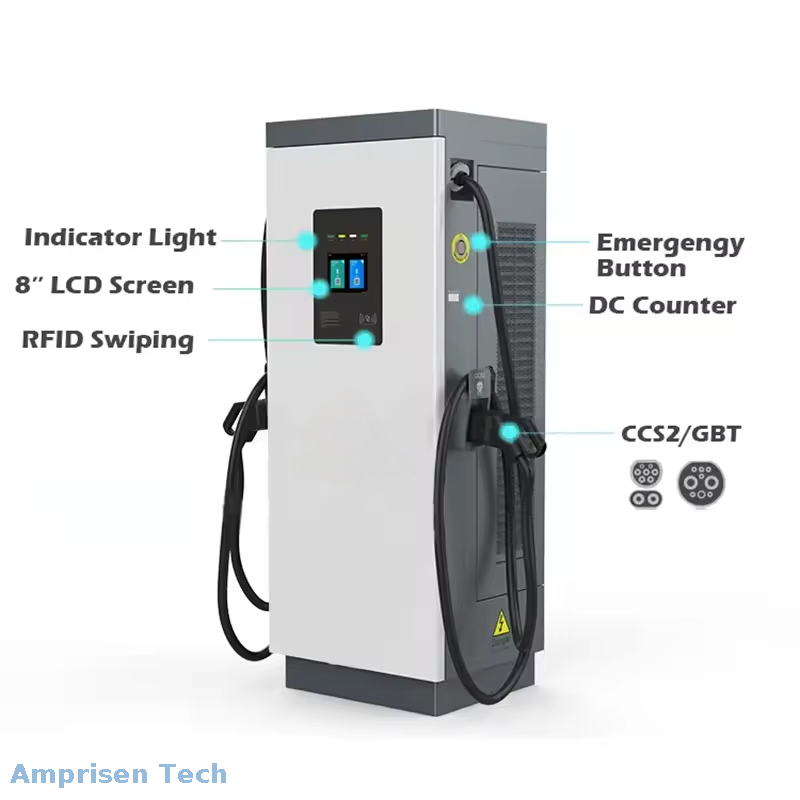
Amprisen DC EV chargers support higher-power charging projects where fast turnaround, OCPP backend control, durable outdoor installation, and commercial operation requirements are important. Buyers can use this page to compare compact DC chargers and high-power 250kW-class fast charger requirements before quotation.
A DC EV charger bypasses the vehicle onboard AC charger and is used when public, fleet, corridor, or commercial sites need faster turnaround, higher utilization, OCPP operation, and planned service access.
Specification focus for buyers
| Decision area | What to confirm |
|---|---|
| Site power | Confirm transformer capacity, available electrical upgrade, target charging speed, and expected daily utilization. |
| Connector mix | Choose CCS, CHAdeMO, GBT, or other connector options by vehicle fleet, market, and public charging requirements. |
| Operation | Define OCPP backend, payment, RFID, screen, network, remote diagnosis, uptime, and service responsibility. |
| Installation risk | Plan cooling, enclosure, cable reach, parking layout, safety clearance, maintenance access, and spare parts. |
Key capabilities
- 20kW to 250kW DC fast charging range
- 250kW-class high-power public charging project support
- Compact DC and high-power public charging options
- OCPP backend integration and remote management options
- Commercial operation, fleet, and corridor charging configurations
Best-fit applications
- Public charging stations
- Fleet depots
- Highway and corridor charging
- Dealerships, service stations, and commercial sites
Selection checklist
- Confirm target power level and grid capacity
- Select CCS, CHAdeMO, GBT, or market-specific connector requirements
- Define OCPP, payment, RFID, network, and screen requirements
- Confirm installation environment, cooling, certification, and service access needs
Procurement fit
DC EV chargers fit public charging, fleet depots, service stations, commercial corridors, and high-utilization sites where shorter dwell time is more important than the lower cost of AC charging.
Market and standards notes
Confirm site grid capacity, target power, CCS, CHAdeMO, GBT, or other connector standards, OCPP platform, payment, RFID, screen, cooling, enclosure rating, and service access before hardware selection.
Implementation risks to confirm
DC projects carry higher risk around transformer capacity, installation cost, backend operation, payment flow, uptime, spare parts, heat management, and maintenance responsibility, so site information matters before quotation.
Common buyer questions
When should a project choose DC instead of AC charging?
Choose DC fast charging when vehicles need shorter dwell times, higher daily utilization, public access, or fleet turnaround that cannot be met by AC charging.
What DC charger power range can Amprisen discuss?
Amprisen can discuss compact DC and higher-power fast charging configurations across the 20kW to 250kW range, depending on project requirements.
What matters most for DC fast charger procurement?
The key factors are power level, connector standard, OCPP platform, payment or RFID requirement, site grid capacity, cooling, outdoor rating, maintenance access, certification, and after-sales support.