
Lamppost EV Charger Products
EV charger buying guide
Lamppost EV chargers for curbside and urban charging projects
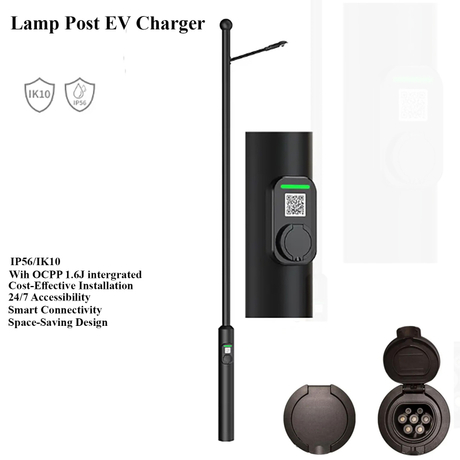
Amprisen lamppost and streetlight EV chargers are designed for cities, parking operators, and infrastructure partners that want to use existing urban assets for accessible AC charging.
A lamppost EV charger uses streetlight or pole infrastructure for curbside AC charging, but each project must verify pole structure, electrical capacity, cable management, public access, and municipal approval.
Specification focus for buyers
| Decision area | What to confirm |
|---|---|
| Pole suitability | Check pole structure, electrical capacity, cable route, access height, and municipal installation rules. |
| Public access | Confirm payment, RFID, backend operation, user signage, vandal resistance, and maintenance process. |
| Cable management | Plan connector storage, cable reach, parking position, weather exposure, and user handling. |
| Approval risk | Review city approval, safety standards, grid connection, and maintenance responsibility early. |
Key capabilities
- Curbside AC charging format
- Streetlight and lamppost integration concepts
- Commercial operation and managed access options
- Project customization for urban deployments
Best-fit applications
- City curbside charging
- Public street parking
- Municipal pilot projects
- Smart lighting and charging integration
Selection checklist
- Confirm pole structure and electrical capacity
- Define public access, payment, and backend requirements
- Check enclosure, cable management, and installation height
- Confirm local safety and municipal approval needs
Procurement fit
Lamppost EV chargers fit curbside, municipal, public street parking, and smart-city projects where existing pole or streetlight assets can reduce the need for separate charging posts.
Market and standards notes
Confirm pole structure, electrical capacity, access height, public access rules, payment or operator backend needs, cable management, enclosure rating, and municipal approval before choosing this format.
Implementation risks to confirm
Project risk usually comes from civil approval, pole load limits, wiring route, vandal resistance, user cable handling, maintenance access, and city-specific safety rules rather than charger electronics alone.
Common buyer questions
Where are lamppost EV chargers most useful?
They are useful in urban curbside environments where streetlight or pole infrastructure can support accessible AC charging without building separate charging posts everywhere.
Do lamppost chargers need project customization?
Usually yes. Pole structure, electrical supply, cable management, access control, and municipal installation rules should be reviewed for each project.
Can lamppost charging be managed through a backend?
Backend management can be discussed when the project requires user access control, monitoring, records, or operator management.