
Should German Fleet Buyers Wait for V2G or Buy AC Chargers Now?
Bidirectional charging in Germany has stopped being a trade-fair promise. On 13 October, Mercedes-Benz and The Mobility House launched a vehicle-to-grid package that private customers can actually order — a dedicated DC wallbox, a dedicated tariff, and payment for every hour the car stays plugged in. It is a genuine milestone. It is also a narrow one. If you buy charging hardware for a fleet or a housing portfolio, the useful question is not whether V2G has arrived. It is where this first package applies, where it does not, and what to do about the charging you need today.
1. What was actually launched
The package is called MB.CHARGE Home Pro Intelligent. It combines the ChargeLine BiDi, an 11 kW bidirectional DC wallbox developed by The Mobility House with EcoG and Zhejiang EV-Tech, with the Mercedes-Benz Intelligent Pro Eco Tariff.
The commercial terms are specific. The wallbox costs €2,990. The first 500 customers pay €1,990 until the end of March 2027 and receive a €250 credit for public charging. While the car is connected at home, the owner is paid €0.1175 per hour — whether the car is charging, discharging or simply waiting. Mercedes-Benz calculates that a car connected for an average of twelve hours a day can earn more than €500 a year, putting payback at about four years on the introductory price and six years at full price. Those are the manufacturer’s own figures, and they depend entirely on connected time.
Two launch conditions matter more than the price. The package works only with the electric GLC and the new C-Class, with more models to follow, in some cases via an over-the-air update. And it is offered only to households without rooftop solar.
2. Why this V2G package is DC, vehicle-specific and tariff-bound
None of those limits is an accident. A car battery stores direct current, so feeding power back means converting DC to AC somewhere. Here the conversion happens in the wallbox, which is why the product is an 11 kW DC unit rather than a familiar AC wallbox — and why it costs what it does. Car and wallbox must also negotiate charging and discharging through ISO 15118-20, the standard Mercedes-Benz says the package is built on. A vehicle without that capability cannot take part, however new it is.
The hardware is only half the system. The offer requires a smart meter, and the earnings come from a specific tariff operated with The Mobility House. Remove the tariff and there is no revenue — only an expensive wallbox. V2G, as launched, is not a charger you buy. It is a service contract with a charger attached.
3. What MiSpeL changed — and what is still pending
The regulatory enabler is MiSpeL, short for Marktintegration von Speichern und Ladepunkten — the market integration of storage and charging points — published by the Federal Network Agency at the start of October. MiSpeL makes it workable to market stored energy from cars without the battery being treated like a conventional power plant.
MiSpeL also explains the solar exclusion. Households with rooftop PV are left out for now because it cannot yet be separated cleanly whether the battery was charged with solar or grid power — a distinction that affects feed-in payments under the Renewable Energy Act. That separation is expected to follow from MiSpeL, and grid operators have until the end of September 2027 to implement the new rules. The full version of this market is still being built, on a timetable that runs for another year.
4. The boundary: where V2G fits, and where it does not
V2G fits a specific picture: a compatible new car, parked at its own home wallbox for long stretches, with a driver willing to trade battery availability for tariff income. For that driver, this package is worth pricing.
Most commercial charging demand looks different. A fleet manager whose drivers take company cars home needs every driver charging tonight, with a session record the company can reimburse — across whatever cars the fleet already runs, including leased vehicles that will never receive a V2G update. A landlord or employer needs points that work this quarter, without tying each space to one car brand and one tariff. For all of these, the binding constraint is not the direction of power flow. It is coverage, records and time to deploy.
That is the job portable AC charging was built for. A portable OCPP charger plugs into an existing socket, needs no wallbox installation, follows the driver between sites, and reports each session to the backend over its own connection. It charges in one direction only — and for reimbursement and fleet rollout, one direction is the whole requirement.
5. A practical decision: wait, pilot, or buy now
*Wait* if your use case is genuinely the V2G picture above: a compatible vehicle, long home dwell times, no rooftop solar, and no charging gap to fill meanwhile.
*Pilot* if you manage a larger fleet or portfolio and want the option value. Put a few bidirectional points where the vehicle fit is certain, measure real connected hours and real credits — not brochure hours — and let that data size any wider rollout.
*Buy now* if drivers already charge company cars at home without records, or if your requirement is reimbursement-ready session data rather than energy trading. There, waiting does not save money. It extends the period in which charging happens unrecorded.
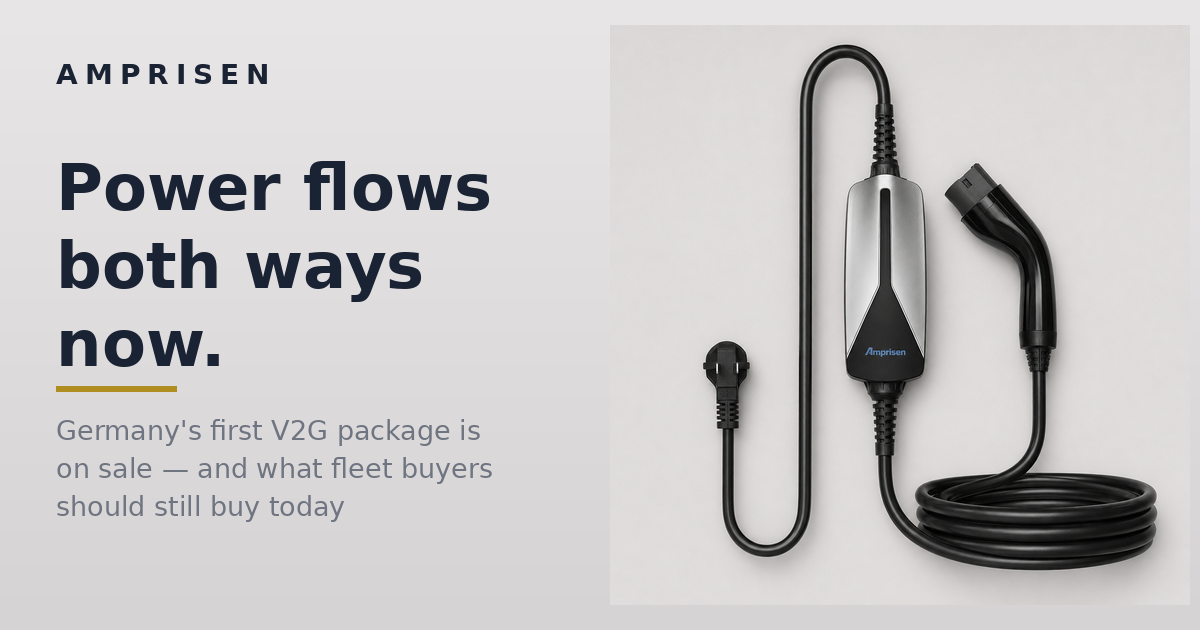
Our own position is easy to state: Amprisen portable chargers are AC, unidirectional devices with OCPP 1.6J and built-in 4G. They do not feed power back to the grid. What they do is deploy today, on the cars and sites fleets already have, and produce the session records that reimbursement runs on. Bidirectional charging has earned its place in the German market this month. It has not changed what most fleets need to buy this quarter.
Explore related EV charging topics
These topic links help readers and search engines connect this article with related market, product, and application pages.
Project notes for EV charging buyers
EV charging project notes and buyer guidance
Use this article to understand product selection, market standard, and project requirements before contacting Amprisen.
Main topic
EV charger market and product insight
Product relevance
Related news category: Industry News
Next step
Share target market, connector standard, power range, quantity, certification, and backend requirements before quotation.
Buyer checklist
| Market | Residential, commercial, fleet, or public charging |
|---|---|
| Specification | Connector, power, communication, certification |
| Outcome | A clearer product shortlist and quotation request |
Related solution pages
Use these links to move from article context to actual product evaluation.