
Can You Charge an EV at Home Without a Driveway in England Now?
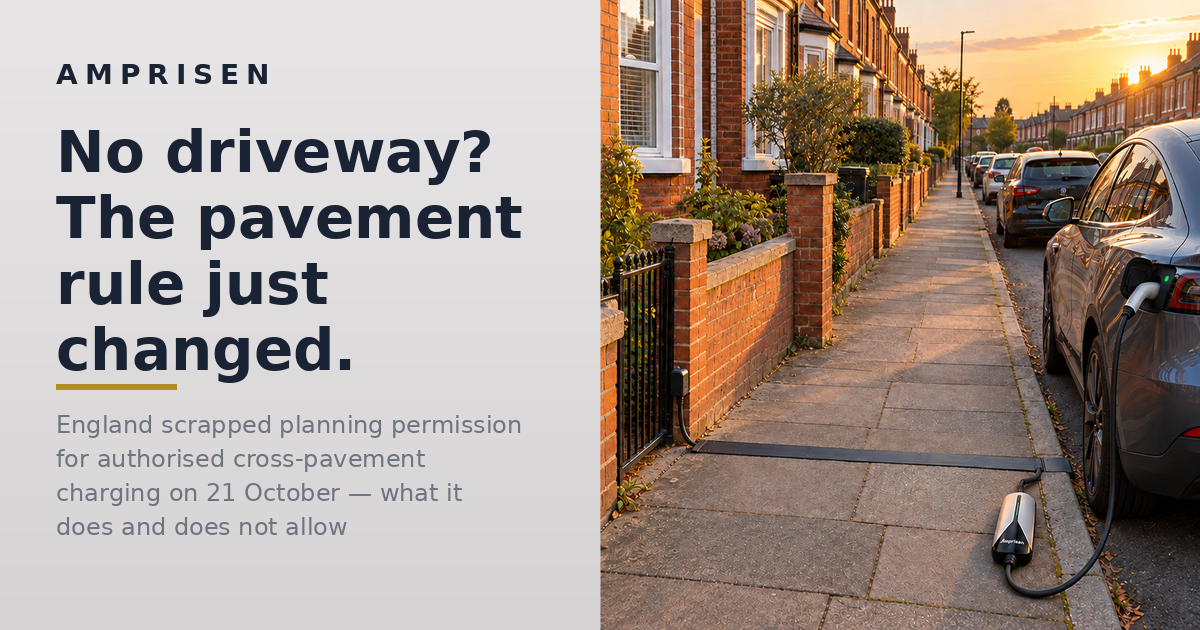
For years, households locked out of cheap home charging in England were not blocked by charger technology. They were blocked by a pavement. If you park at the kerb, the channel carrying a cable safely across the footway counted as development and needed its own planning application. On 21 October 2026, that barrier was removed. What changed — and what very much did not — is worth reading carefully before anyone buys hardware.
1. What changed on 21 October
The change comes from the Town and Country Planning — General Permitted Development — England — Amendment No. 2 Order 2026, made on 25 September, laid before Parliament on 30 September and in force from 21 October.
It does two things. First, a new Class F right makes a cross-pavement solution permitted development: an embedded cable channel no longer needs a planning application, provided it is installed by, on behalf of, or with the authorisation of the highway authority. Second, home charge point rights were widened. A wall-mounted outlet under Class D, or an upstand under Class E, can now sit anywhere within the boundary of a house or block of flats — not only on a driveway. Where a footway sits between outlet and car, the cable must cross it through the authorised channel.
The government says removing the planning step can save up to £300 on installation, and that cross-pavement charging gives these households access to domestic electricity prices — home charging from as little as 2p per mile, with running-cost savings of up to £1,750 compared with relying on public charging. Those are the Department for Transport’s figures, presented as such. The audience is large: English Housing Survey figures, cited in the government’s consultation response, put households in England without off-street parking at about eight million, roughly 32 percent.
2. What did not change
Planning permission is gone. Permission is not.
The pavement is still the highway authority’s. The new right covers only a channel the authority installs, has installed, or authorises — it is not a licence for a resident to cut into the footway, and every household still goes through its council’s highways process and local rules. Practice will therefore vary by council, at least at first.
A loose cable still does not qualify: the law defines the solution as a channel embedded in the pavement, and a cable trailed across the footway, with or without a cover or mat, is not that channel. Nor does the right reserve the parking space outside your house. And it has hard exclusions: no Class F development within a scheduled monument site, within the boundary of a listed building, or in a conservation area, and the channel must be removed and the pavement reinstated when no longer needed.
Two confusions deserve plain words. The permitted outlet is a dedicated charging point — the legislation expressly excludes a standard domestic plug and socket. And for tenants, this Order does not settle the landlord question: consultations on tenant and leaseholder access run to 16 December 2026, and until that becomes law, renters still need their landlord’s route, not just the council’s.
3. The conditions installers will work to
The detail that decides real installations sits in Class D. A wall outlet outside a parking area is limited to one outlet per house or block of flats, must sit no more than 1.6 metres above ground level, and is not permitted in a conservation area. Where the wall directly adjoins the highway, it may project no more than 0.2 metres, with at least 1.5 metres of footway remaining to the carriageway. Similar thinking runs through Class E for upstands. None of this is onerous — but it is specific, and the council’s authorisation, not the planning portal, now gates the job.
4. Where portable charging fits — and where it does not
A portable charger does not change any of the above. The authorised channel is the infrastructure the new law is about; no charger, portable or fixed, replaces the highway authority’s authorisation.
What portable charging does change is the hardware side of the same problem. The charger is not fixed to one wall or one address: it can move with the driver between a home with an authorised channel, a workplace and a second property, and a connected portable charger with OCPP and its own mobile connection still reports every session — the record that matters when a company car driver charges at home and the employer reimburses the electricity. For installers, the widened rights create a new, repeatable job type in terraced streets: authorise the channel, fit the dedicated point within the Class D limits, and hand over a setup that works the same evening.
5. A five-step checklist before you spend anything
*Step one:* check the exclusions first — conservation area, listed building or scheduled monument can each end the permitted route.
*Step two:* start with your council as highway authority, not with a charger purchase. Ask how it authorises channels and which installers it works with.
*Step three:* plan the dedicated charge point against the Class D limits — position, height, projection and remaining footway width — before ordering.
*Step four:* check current grant eligibility before installation begins, because grants in this area normally cannot be claimed retrospectively.
*Step five:* choose the charger around how the car is used — fixed at one address, or portable across home, work and travel, with session records if an employer pays for the energy.
England has not made kerbside home charging automatic. It has made it a single-authorisation job instead of a planning case — the difference between home charging being theoretically possible and actually bookable. Amprisen portable chargers are OCPP 1.6J devices with built-in 4G, made to be carried and to record sessions wherever a driver legitimately charges. The pavement now has a lawful route across it. The rest is doing the steps in the right order.
Explore related EV charging topics
These topic links help readers and search engines connect this article with related market, product, and application pages.
Project notes for EV charging buyers
EV charging project notes and buyer guidance
Use this article to understand product selection, market standard, and project requirements before contacting Amprisen.
Main topic
EV charger market and product insight
Product relevance
Related news category: Industry News
Next step
Share target market, connector standard, power range, quantity, certification, and backend requirements before quotation.
Buyer checklist
| Market | Residential, commercial, fleet, or public charging |
|---|---|
| Specification | Connector, power, communication, certification |
| Outcome | A clearer product shortlist and quotation request |
Related solution pages
Use these links to move from article context to actual product evaluation.