
Will Your Next EV Charger Need ISO 15118-20 From 1 January 2027? What EU Buyers Should Ask Now
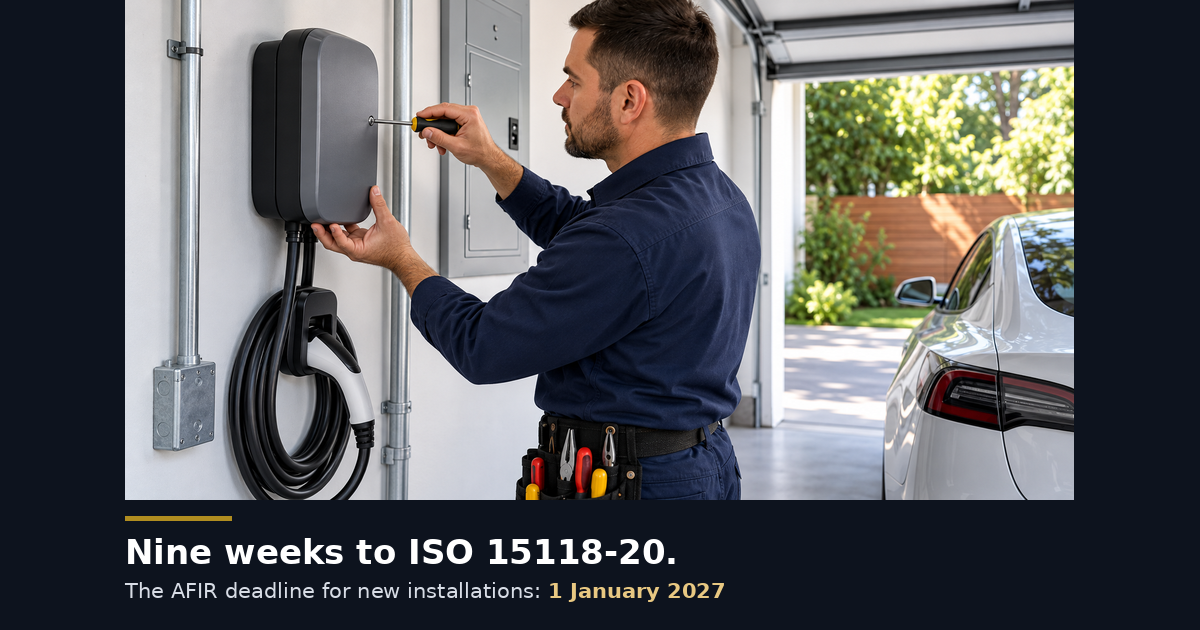
On 21 October, Enphase Energy announced that its IQ EV Charger 2 already supports ISO 15118-20, so distributors and installers can keep selling it as is — no new part number, no inventory adjustment, no action for chargers already installed. When compliance is marketed as “nothing changes for your stock”, it tells you what the channel fears. About nine weeks before the deadline, the risk is not missing a trend. It is ordering the wrong hardware for installations delivered after 1 January 2027.
This article covers only the buying decision — and the questions to settle before your next order.
1. What the 1 January 2027 rule actually covers
The requirement sits in the Alternative Fuels Infrastructure Regulation — AFIR, Regulation (EU) 2023/1804 — as amended by Commission Delegated Regulation (EU) 2025/656. From 1 January 2027, newly installed or renovated publicly accessible AC and DC charging points must comply at least with EN ISO 15118-20:2022. Newly installed or renovated private Mode 3 and Mode 4 points must do the same.
Three boundaries do the practical work. First, the trigger is installation or renovation on or after the date — chargers already installed are not retrospectively caught, which is why Enphase could tell its installed base that no action is required. Second, the private-point duty is scoped to Mode 3 and Mode 4, so classification matters and should be confirmed, not assumed. Third, “renovated” has no single precise definition; Commission guidance treats it case by case. For a substantial rebuild, get the classification in writing before you price the job.
This is the second step, not the first. Since 8 January 2026, new or renovated public AC points have already had to support ISO 15118-2. The 2027 step moves the baseline to -20 and extends it to private Mode 3 and Mode 4 points.
2. What ISO 15118-20 support gives you — and what it does not
ISO 15118 is the communication protocol between vehicle and charge point. The -20 version carries the advanced functions the market talks about most: Plug and Charge, where the car authenticates itself with a stored contract certificate so charging starts on plug-in without an app or a card; more advanced smart charging; and the framework for bidirectional power transfer.
Supporting the standard is not the same as every service being live. Plug and Charge still depends on a compatible vehicle, a backend that handles certificates, and a public key infrastructure behind it. Bidirectional operation needs still more — vehicle, power electronics, firmware, metering, protection, and permission to export. “ISO 15118-20 ready” answers the communication question alone.
There is also a hardware reality behind the software language. ISO 15118 runs over power line communication on the charging cable, so PLC capability must be present in the hardware. The honest question is never just “will there be a firmware update?” It is “is this exact model, as shipped, already compliant — and what evidence supports that?”
3. Stock, pipeline and installed base: three different answers
For the installed base, the answer is calm: the deadline does not force a rip-and-replace of points installed before 2027. Do not let anyone sell you a replacement programme on AFIR grounds alone.
For stock and pipeline, the answer is strict. Any fixed Mode 3 or Mode 4 point newly installed or renovated on or after 1 January 2027 needs the -20 baseline — including units ordered this quarter for projects completing in the new year, and framework agreements rolling into 2027. Enphase’s “no SKU change” message is powerful precisely because it removes this question for one product line. For every other line on your shelf, the question needs an explicit answer per model, in writing, before you order.
For tenders, the answer is documentary. Ask for declaration or test evidence for the exact variant quoted — not a roadmap statement, and not evidence for a different model in the same family.
4. The honest boundary for portable AC charging
Our own product makes this boundary concrete. Amprisen portable chargers communicate over OCPP 1.6J including Smart Charging, with built-in 4G, and carry CE and CB certification. They do not support ISO 15118-20, do not offer Plug and Charge, and are not bidirectional. Do not buy a portable charger to satisfy a fixed-point tender requiring ISO 15118-20 — it is the wrong tool for that specification, whoever supplies it.
The portable unit solves a different, current job: a company car charged at the driver’s home, where the employer needs a recorded session for reimbursement, without a fixed installation project. The question there is session records, connectivity and backend control — not Plug and Charge. Confusing the two jobs is how fleets over-buy fixed infrastructure for a home problem, or under-buy capability for a site judged against the 2027 baseline.
5. Five questions to ask before your next order
- Is this exact model, as shipped today, compliant with EN ISO 15118-20:2022 — and what declaration or test evidence supports it?
- Is compliance built into the shipped hardware including PLC, or does it depend on a future firmware release with a committed date?
- If Plug and Charge is promised, what else must be in place — vehicle, backend, certificates — and what is included in this quote?
- For projects completing after 1 January 2027, does this quote cover newly installed or renovated points under the amended AFIR?
- Where Plug and Charge is not needed, what does the charger record per session, and how does the operator get that data out?
Nine weeks is enough time to ask five questions, not to reorder a warehouse. Check your pipeline now, while the answer is still a purchasing decision.
Amprisen supplies portable AC charging with OCPP 1.6J and built-in 4G for company-car home charging and reimbursement — including honest advice on where a fixed ISO 15118-20 point is the right answer instead. www.amprisen.com
Explore related EV charging topics
These topic links help readers and search engines connect this article with related market, product, and application pages.
Project notes for EV charging buyers
EV charging project notes and buyer guidance
Use this article to understand product selection, market standard, and project requirements before contacting Amprisen.
Main topic
EV charger market and product insight
Product relevance
Related news category: Industry News
Next step
Share target market, connector standard, power range, quantity, certification, and backend requirements before quotation.
Buyer checklist
| Market | Residential, commercial, fleet, or public charging |
|---|---|
| Specification | Connector, power, communication, certification |
| Outcome | A clearer product shortlist and quotation request |
Related solution pages
Use these links to move from article context to actual product evaluation.