
What Counts as Proof for Home Charging Reimbursement in Bavaria — Do You Need an MID or Eichrecht Meter?
Ask a German fleet manager what a driver needs to prove home charging costs, and the answer usually comes back as a meter question: does the charger need an MID meter, or even a meter that conforms to German calibration law, known as Eichrecht? In Bavaria, the state tax office has now answered a different and more practical question. For tax purposes, what matters is not only how the electricity was measured. What matters is what the evidence looks like.
What the Bavarian tax office has clarified
In a ruling dated 18 June 2026, file reference S 2334.1.1-73/11 St36, the Bavarian State Tax Office — the Bayerisches Landesamt für Steuern — addressed how employees prove the electricity they use at home to charge a company car that is also available for private use. Employer reimbursement of those costs is tax-free under Section 3 No. 50 of the German Income Tax Act. The hard part has always been evidencing the amount correctly.
The ruling allows the amount of electricity to be measured by a meter in the wallbox or charger, or by a meter inside the vehicle itself. It then states the point that changes purchasing conversations: an MID meter or a meter conforming to Eichrecht is not required for this tax evidence.
Two scope notes belong right next to that sentence. First, this is a Bavarian state ruling. It is not a nationwide rule, and fleets outside Bavaria should not treat it as one. Second, it answers a tax-evidence question. It does not change the separate rules that can apply when electricity is sold or billed to third parties at public or semi-public charging points.
What counts as evidence
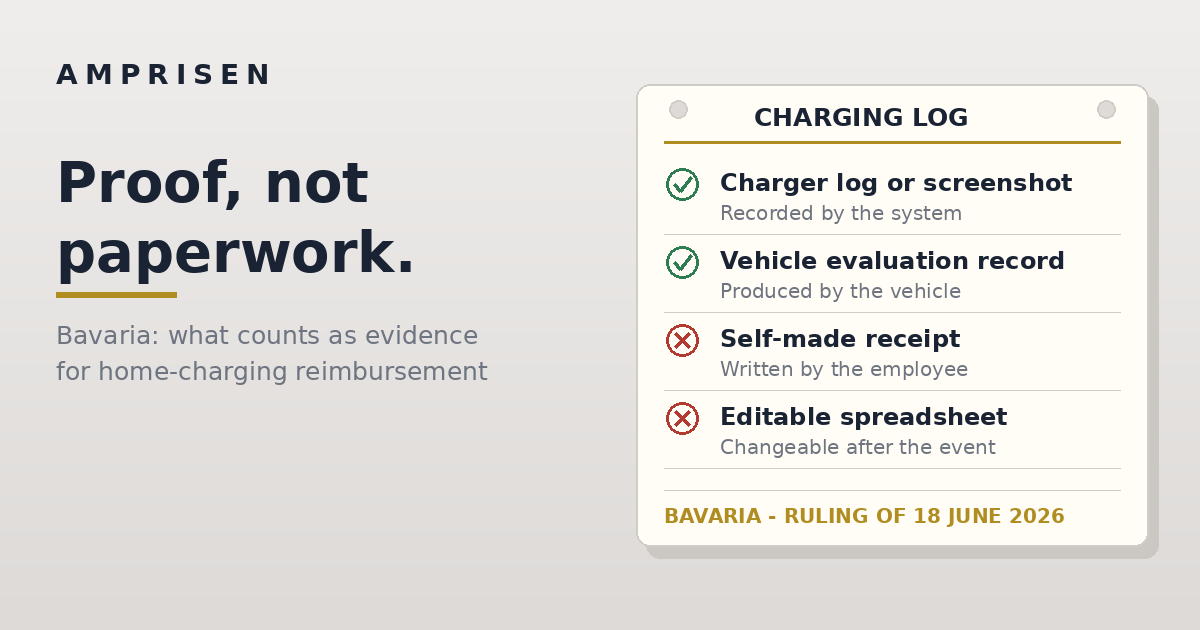
The ruling accepts evidence that comes straight from the charging equipment or the vehicle. Screenshots taken from the logs or protocols of the wallbox or charger are accepted, as are the evaluations generated by the vehicle itself. In plain terms, the record has to originate in a system. It has to show the charging session as the equipment recorded it, not as someone later reconstructed it.
That distinction is the real message. A session log created automatically at the time of charging is evidence. A document the employee creates afterwards is only a claim about evidence — and the tax office treats the two very differently.
For fleets, this turns evidence into a workflow question. Can the charger record each session without the driver doing anything? Can that record be retrieved later, matched to the driver and the vehicle, and filed by payroll? A charger that produces its record automatically answers those questions by design. One that leaves the driver to write the session down answers none of them.
What does not count
The ruling is equally clear about what is not accepted. Self-made receipts prepared by the employee are not admissible as proof. Neither are editable spreadsheet listings — the ruling names changeable Excel records as not permitted. If a person can quietly adjust the numbers after the event, the document does not prove the event.
This is where many home-grown processes fail. A tidy spreadsheet, filled in carefully at month end, looks like good administration. Under this ruling it is exactly the wrong artefact: editable, self-produced, and detached from the equipment that did the measuring. Fleets still running reimbursement on driver-maintained lists should move the record-keeping into the charger and its backend, where the session is written once, by the system, at the moment it happens.
Two details fleets often miss
The ruling covers two further points. First, losses that occur during charging can also be reimbursed tax-free, because they are economically attributable to the charging process itself. Second, the reimbursement must be recorded in payroll, in the record for the pay period in which it is paid out. A monthly settlement is not required — fleets have freedom in how often they pay out, as long as the record lands in payroll when they do.
What this means when you choose a charger
For a Bavarian fleet, the buying question shifts. Instead of asking first whether a home charger carries a particular meter certification, ask whether it produces usable evidence on its own: a session record generated by the device, retrievable through its backend, and exportable for payroll. Meter certification can still matter for other reasons and in other settings, and a tax adviser should confirm the setup for your own case before you standardise on it. But for this specific tax question in Bavaria, an expensive certification hunt is not where the ruling points. It points at the record.
That is also how we build at Amprisen. Our portable chargers record every charging session through OCPP 1.6J, with built-in 4G connectivity and a built-in meter, so the session data exists in the system from the start and can be exported for reimbursement files — no wall installation, and no driver-maintained spreadsheet in between. The evidence habit the Bavarian ruling asks for is the habit a connected charger already has.
A five-point evidence checklist for fleets in Bavaria
- Measure with a system: the charger or the vehicle records the electricity, not the driver.
- Keep the original record: file the charger log or screenshot from the system, not a retyped summary.
- Retire the spreadsheet: editable, self-made listings do not count as proof.
- Record it in payroll: the reimbursement appears in the payroll record for the period in which it is paid.
- Stay inside the scope: treat this as Bavarian tax guidance, confirm your own setup with your tax adviser, and do not extend it to public billing situations it does not cover.
Home charging reimbursement will keep getting more evidence-based. The fleets that cope best will not have the neatest spreadsheets. Their chargers will write the record for them.
Explore related EV charging topics
These topic links help readers and search engines connect this article with related market, product, and application pages.
Project notes for EV charging buyers
EV charging project notes and buyer guidance
Use this article to understand product selection, market standard, and project requirements before contacting Amprisen.
Main topic
EV charger market and product insight
Product relevance
Related news category: Industry News
Next step
Share target market, connector standard, power range, quantity, certification, and backend requirements before quotation.
Buyer checklist
| Market | Residential, commercial, fleet, or public charging |
|---|---|
| Specification | Connector, power, communication, certification |
| Outcome | A clearer product shortlist and quotation request |
Related solution pages
Use these links to move from article context to actual product evaluation.