
Dynamic Load Balancing: Add EV Chargers Without Upgrading Your Grid Connection
For most commercial sites, the binding constraint on EV charging is not the chargers. It is the grid connection. A depot can buy twenty chargers tomorrow; getting the additional grid capacity to run them all at once is a different project entirely — slower, more expensive, and controlled by someone else. Dynamic load balancing is how smart sites add charging points under the connection they already have.
1. The upgrade nobody budgets for
When a site’s charging plan exceeds its grid connection, the textbook answer is a connection upgrade: a bigger cable, a new transformer, civil works, and the distribution operator’s approval process. In practice this is routinely the longest pole in a depot electrification project — measured in months, not weeks — and its cost can dwarf the charging hardware itself. Many fleet projects do not fail on charger selection. They stall waiting for capacity.
That is why the most valuable question in early project planning is not “which charger?” but “how much headroom does this site actually have, and when?” Most commercial buildings have significant spare capacity outside their own peak hours. The trick is using it.
2. Static splitting wastes what dynamic balancing finds
The crude version of load management is static: divide the available power evenly among all chargers, permanently. It is simple and it is wasteful — every charger is throttled even when the building next door is drawing almost nothing.
Dynamic load balancing works from live data instead. A meter at the grid connection point reports the site’s real-time total load; the charging backend continuously recalculates how much headroom remains and distributes it across the chargers that need it right now. When the building’s own demand drops in the evening, the freed capacity flows to the vehicles automatically. When the morning peak returns, charging throttles back. No fixed split, no stranded capacity — the site simply never exceeds its connection limit, whatever the chargers are doing.
3. How OCPP makes it interoperable
This is not a single-vendor trick. In an OCPP-managed site, the backend (CSMS) already talks to every charger; load balancing adds one more instruction type to that conversation: charging profiles that cap each charger’s power, updated as conditions change. Because it runs over the open protocol, a site can mix charger brands under one load management policy — the backend does not care whose logo is on the housing, only that the charger obeys the profile it is given.
Two prerequisites decide whether it works in practice. First, the chargers must actually accept and follow charging profiles — an OCPP line on a datasheet is not the same as a tested implementation. Second, the site needs metering at the grid connection point that the backend can read; without a live view of total site load, there is nothing to balance against.
4. The market is moving this way
The industry signal arrived this month: Electric Miles and Charge-M8 announced an integration pairing the Libra dynamic load balancing device with the emPACT platform, letting multi-charger commercial sites automatically share live available power over OCPP (announced October 2, reported October 5). The pitch is exactly the one above — more chargers on the connection you have, instead of paying for a bigger one.
It is worth reading this as a pattern, not a one-off. Load balancing is graduating from a premium feature to expected infrastructure, the way smart charging did a few years ago. Sites specifying chargers today should assume their backend will be asked to do this tomorrow.
5. From cost avoidance to revenue
There is a second half to this story. A site whose charging load can be dialed up and down on instruction owns something the grid increasingly wants to buy: flexible demand. Grid operators and aggregators in a growing number of European markets procure flexibility — paying controllable loads to reduce draw at stressed moments. A load-balanced charging site is already controllable by construction; participating is a commercial decision layered on top of the technical one, not a new installation.
The honest framing matters here. Flexibility revenue will not finance your chargers on its own, and program terms vary by market. But the direction is one-way: controllable load is becoming an asset class, and the sites that balance their charging today are the ones positioned to sell that control tomorrow.
6. What to specify
If you want this capability, put it in the tender — it does not appear by accident:
- Chargers that obey charging profiles. Confirm OCPP smart charging is enabled and tested with the backend you plan to use, not merely listed as a feature.
- A backend with real load management. “OCPP-compatible” is not enough; ask how it reads site-level metering, how often it recalculates limits, and how it prioritizes vehicles when headroom is tight.
- Metering at the grid connection point. The whole system balances against this number. It must be live, accurate, and visible to the CSMS.
- A safe fallback. If the backend connection drops, chargers should fall back to a conservative default — limited power or timed full charge — rather than freezing or, worse, ignoring limits. Ask about offline behavior before you need it.
7. Where portable chargers fit
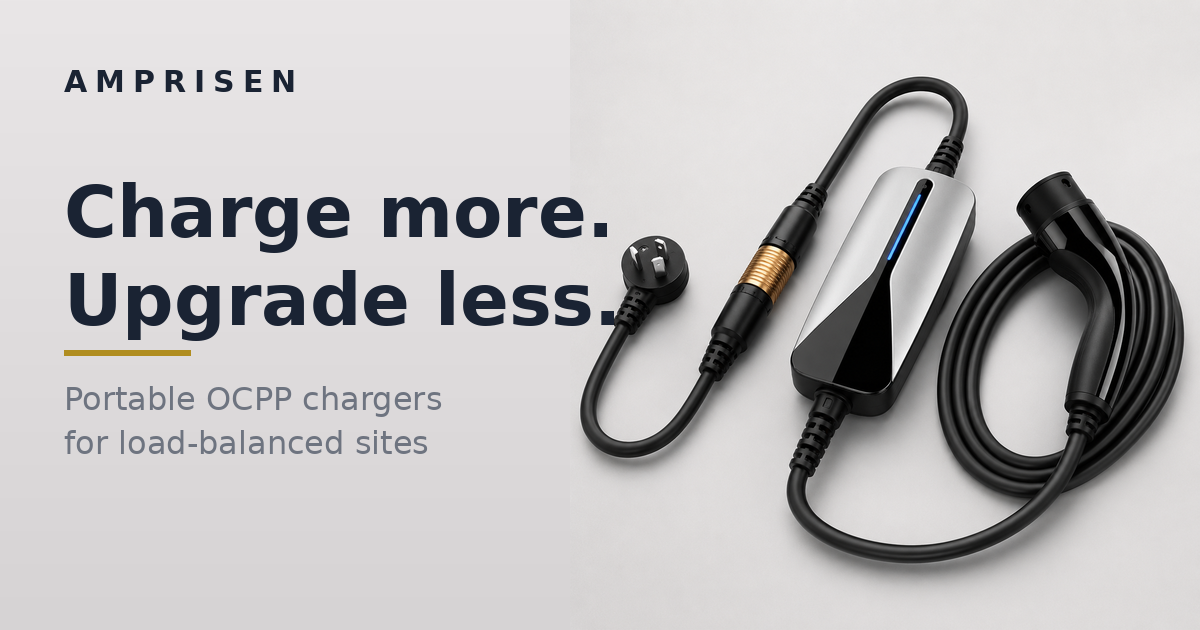
Fixed chargers are not the only way to add charging points. A portable charger that speaks OCPP joins the same managed site as any wallbox — drawing from the same dynamically allocated pool, with no new fixed infrastructure to install. For sites whose vehicle count fluctuates, or that want to trial charging before committing to civil works, that flexibility is the point: capacity first, concrete later.
At Amprisen, our portable OCPP 1.6J chargers (7/11/22 kW) are built for exactly these sites — 4G-connected, MID-metered, and ready to take charging profiles from any OCPP backend running load management, with CE + CB certification.
Explore related EV charging topics
These topic links help readers and search engines connect this article with related market, product, and application pages.
Project notes for EV charging buyers
EV charging project notes and buyer guidance
Use this article to understand product selection, market standard, and project requirements before contacting Amprisen.
Main topic
EV charger market and product insight
Product relevance
Related news category: Industry News
Next step
Share target market, connector standard, power range, quantity, certification, and backend requirements before quotation.
Buyer checklist
| Market | Residential, commercial, fleet, or public charging |
|---|---|
| Specification | Connector, power, communication, certification |
| Outcome | A clearer product shortlist and quotation request |
Related solution pages
Use these links to move from article context to actual product evaluation.