
How Can a Small EV Charger Installer in Germany Earn Recurring Revenue Instead of Only One-Off Installation Fees?
An installation is a good day. The invoice is paid, the charger works — and then the relationship quietly ends until something breaks. For a small electrical firm, that pattern has a hidden cost: every month starts at zero, and every new euro has to be won with a new quote and a new installation slot.
The alternative is not to become a software company. It is to sell the part of charging that continues after installation day, in a package a small team can actually deliver.
Why the market is moving this way
This week, ChargePoint launched a new channel partner programme for resellers across Europe, explicitly designed to help partners build recurring revenue through software, managed services and ongoing customer support rather than hardware margin alone. When the largest networks organise their partner business around services, it is a signal about where the durable margin in charging sits — and small installers can build the same logic at their own scale, with their own local customers.
The reason is simple. A workplace, a fleet or a landlord does not really buy a charger. They buy drivers who can charge without calling anyone, sessions recorded correctly, and a named person to contact when something stops working. Hardware delivers that only on day one. Keeping it true in year two is a service — and services can be contracted and planned around, in a way one-off work cannot.
The three layers a small installer can honestly sell
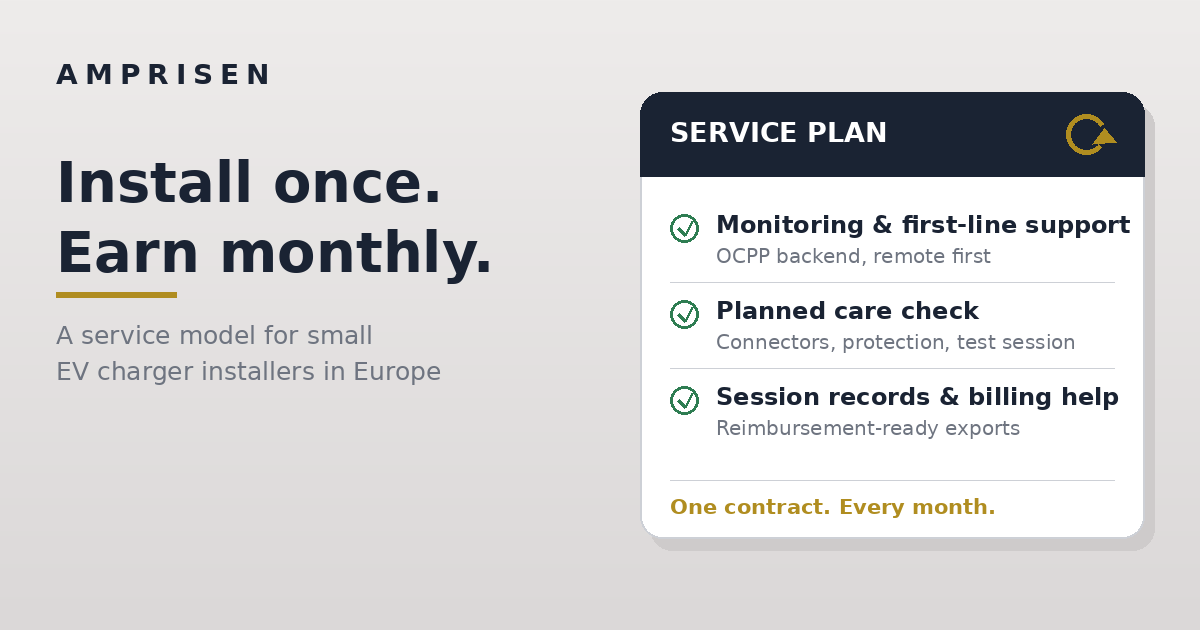
Layer one: monitoring and first-line support. A networked charger that speaks OCPP can report its status to a backend. That means many problems are visible before the driver reports them, and some — a stuck session, a charger that needs a remote reset or a firmware update — can be resolved without a van roll. Sold plainly, this layer is: we watch your chargers, we are your first call, and we sort out remotely what can be sorted out remotely.
Layer two: planned care and checks. Connectors, cables, enclosures and protective devices live outdoors and get used by people who never read the manual. A scheduled visit that inspects the physical installation, checks the electrical protection, tests a real charging session and confirms the charger is talking to its backend is easy for a customer to understand and easy to schedule in quiet weeks. It also catches small faults while they are still small.
Layer three: billing and administration help. For company-car charging at employees' homes and for small fleets, the charger's second job is paperwork: recorded sessions, per-driver totals and exportable records for reimbursement or internal cost allocation. Many small employers do not want to run a backend themselves. An installer who sets this up at handover and stays responsible for keeping the records flowing is selling relief from a monthly chore — and that is worth a monthly fee in a way a one-off configuration charge is not.
Write the contract so a small team can keep it
Recurring revenue fails when the promise is bigger than the team. A workable service contract for a small firm is specific about four things. First, scope: which chargers, which sites, and which of the three layers are included. Second, response: how a fault is reported, when a remote check happens, and when a site visit follows — stated in working hours a small team can honour, not round-the-clock language copied from a large operator. Third, exclusions: spare parts, vandalism and damage caused by third parties are either included at a stated price or clearly outside the fee. Fourth, exit: who owns the backend account and the session data, and what happens to both if the customer changes service provider. Open, OCPP-based hardware helps here, because the customer is not locked to one backend — and an installer who says so out loud earns trust that a locked-in competitor has to buy back later.
Two promises to avoid: an uptime guarantee you cannot staff, and compliance claims you cannot document. If a site has metering or billing duties under German rules, name exactly which part you support and which part stays with the customer or their metering provider. A narrow promise kept every month retains customers. A broad promise broken once ends the contract and the referrals that came with it.
Start with the customers you already installed
The cheapest place to launch a service offer is the installed base. Every charger you have already fitted is a site where you know the wiring, the customer and the use case. The offer can be made at the next natural contact — a warranty question, an expansion quote, a routine visit — or in one short letter to past customers: the charger is installed, here is what keeping it running properly involves, here is the monthly package, here is what it does not include.
Structure the work so it scales with the team you have. Remote checks batch neatly into one morning a week. Planned visits cluster by area. Administration help follows the customer's monthly rhythm, not your emergency inbox. The point is not the size of the fee. The point is that part of next month's revenue is already contracted before the month begins, and installation work goes back to being what it should be — the start of a customer relationship, not the whole of it.
Where hardware choice fits
A service model only works if the hardware cooperates: the charger must report its status, accept remote actions and keep recording sessions when connectivity drops. That is why we build our portable chargers on OCPP 1.6J including Smart Charging, with built-in 4G connectivity — an installer can connect them to the backend they already use and run their own service offer on top. We do not run the installer's service desk, and this article is not a partner programme announcement. It is a suggestion, from the hardware side of the table, that the firms best placed to own the customer relationship in European charging are already holding the screwdriver.
Explore related EV charging topics
These topic links help readers and search engines connect this article with related market, product, and application pages.
Project notes for EV charging buyers
EV charging project notes and buyer guidance
Use this article to understand product selection, market standard, and project requirements before contacting Amprisen.
Main topic
EV charger market and product insight
Product relevance
Related news category: Industry News
Next step
Share target market, connector standard, power range, quantity, certification, and backend requirements before quotation.
Buyer checklist
| Market | Residential, commercial, fleet, or public charging |
|---|---|
| Specification | Connector, power, communication, certification |
| Outcome | A clearer product shortlist and quotation request |
Related solution pages
Use these links to move from article context to actual product evaluation.