
How Do Fleets Automate Home Charging Reimbursement for Company Cars?
This week, the UK’s Rightcharge and vaylens announced a partnership to automate home charging reimbursement for fleet drivers: charging-session data from vaylens’ charge-point management software is used to calculate the exact amount due, and Rightcharge settles it directly with the driver’s home energy supplier — at the driver’s actual home tariff. No expense claims. No manual reconciliation.
The announcement lands on a striking imbalance. According to Rightcharge, nearly 70% of fleet charging costs stem from public charging, yet public charging accounts for only 41% of the energy fleets consume. Home charging is where the cheapest kilowatt-hours live. It is also where the paperwork lives — and the industry has now settled on three routes to automate it.
1. Route one: manual expense claims
The status quo. The driver charges the company car at home, submits an expense claim, and someone on the fleet team reconciles it by hand — verifying the session, applying the right tariff, calculating the tax. It works for five cars. At hundreds or thousands of vehicles, it breaks: “The challenge is making reimbursement work across hundreds or thousands of vehicles,” says Russell Olive, vaylens’ UK director. The uncomfortable truth, stated plainly in this week’s reporting, is that the theoretical savings from drivers’ home chargers are “often higher than the reality” — because manual processing quietly eats them.
2. Route two: software identification plus direct settlement
The route this week’s news belongs to. Charging-session data from the charge-point management software identifies exactly how much energy went into the car; the payment platform calculates the precise amount at the driver’s actual home tariff and settles it directly with the driver’s energy provider. No estimates, no guesswork, no expense claims. The fleet receives a single monthly invoice — in the UK, HMRC-compliant — covering home and public charging together. And fraud is addressed by design: vehicle integration verifies that the vehicle being charged is genuinely the company vehicle, so the business can be confident it is reimbursing the right charging activity.
This pattern is repeating across the UK market. Rightcharge has announced similar integrations with Andersen EV and, in late September, with Myenergi’s Zappi charger — where drivers are reimbursed automatically “based on the energy they actually use and their own domestic tariff.”
The honest caveat: this route runs on APIs between separate software platforms, and APIs are living things. As the reporting notes, minor software updates, bugs, cybersecurity issues or outages on either side can break the link — and with it, the automation. Before signing, ask the vendor two questions: what is the fallback when the link breaks, and who carries the maintenance burden as the partnership count grows?
3. Route three: metered hardware
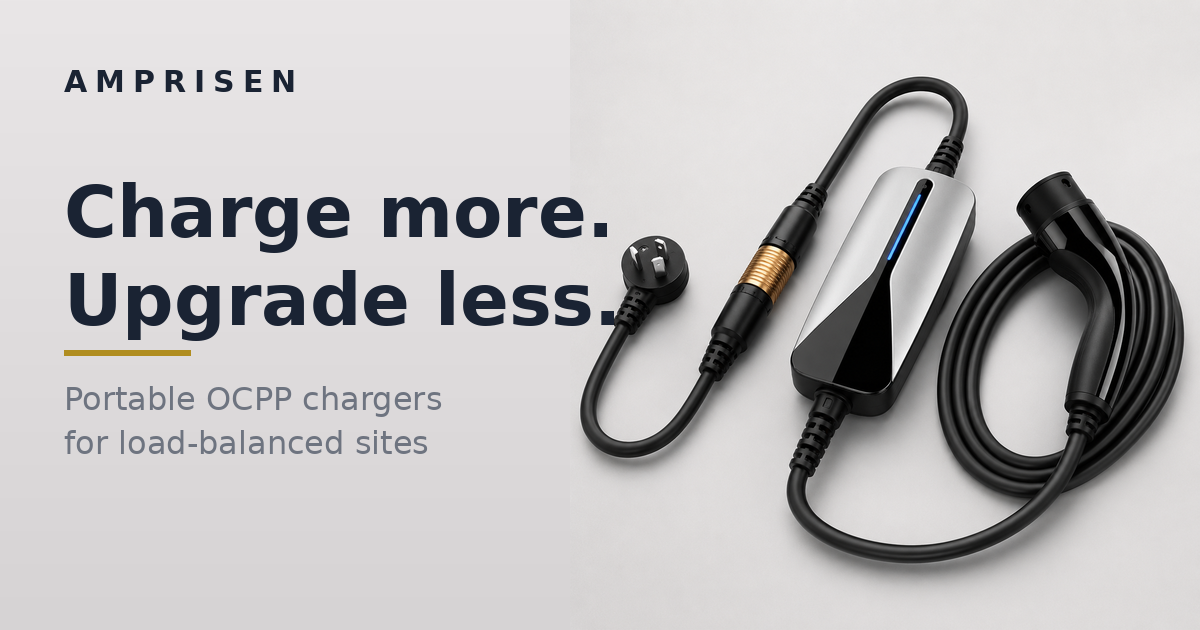
The route where measurement itself is the compliance. A MID-certified meter inside the charger records every kilowatt-hour; the values are signed and carried to the backend over OCPP; reimbursement is based on measured energy. This is the route Germany’s 2026 reimbursement rules effectively require — we covered the regulation in our 29 September piece and the signed-values mechanics in our 2 October piece, so we won’t re-teach them here. The practical point: portable metered chargers bring this route to company cars charged at employees’ homes, without installing a wallbox at every driver’s house.
4. Five questions before you choose a route
- Which country’s rules govern your reimbursement — a measured-kilowatt-hour regime like Germany’s, or a session-data regime?
- What is the data basis — certified metered energy, or charging-session data?
- How is fraud prevented — does the system verify the company vehicle is the one being charged?
- Which tariff is the basis — the driver’s actual home tariff, or a flat estimate?
- What happens when the software link breaks — is there a fallback, and who maintains the integration?
At Amprisen, we build for route three: portable OCPP 1.6J chargers (7/11/22 kW) with 4G connectivity, a built-in meter, tamper-protected firmware, and signed meter values over OCPP — CE and CB certified. Measured energy is reimbursed energy.
Explore related EV charging topics
These topic links help readers and search engines connect this article with related market, product, and application pages.
Project notes for EV charging buyers
EV charging project notes and buyer guidance
Use this article to understand product selection, market standard, and project requirements before contacting Amprisen.
Main topic
EV charger market and product insight
Product relevance
Related news category: Industry News
Next step
Share target market, connector standard, power range, quantity, certification, and backend requirements before quotation.
Buyer checklist
| Market | Residential, commercial, fleet, or public charging |
|---|---|
| Specification | Connector, power, communication, certification |
| Outcome | A clearer product shortlist and quotation request |
Related solution pages
Use these links to move from article context to actual product evaluation.