
What Happens to Your EV Chargers When the Supplier Exits the Hardware Business — and What Should German Buyers Ask First?
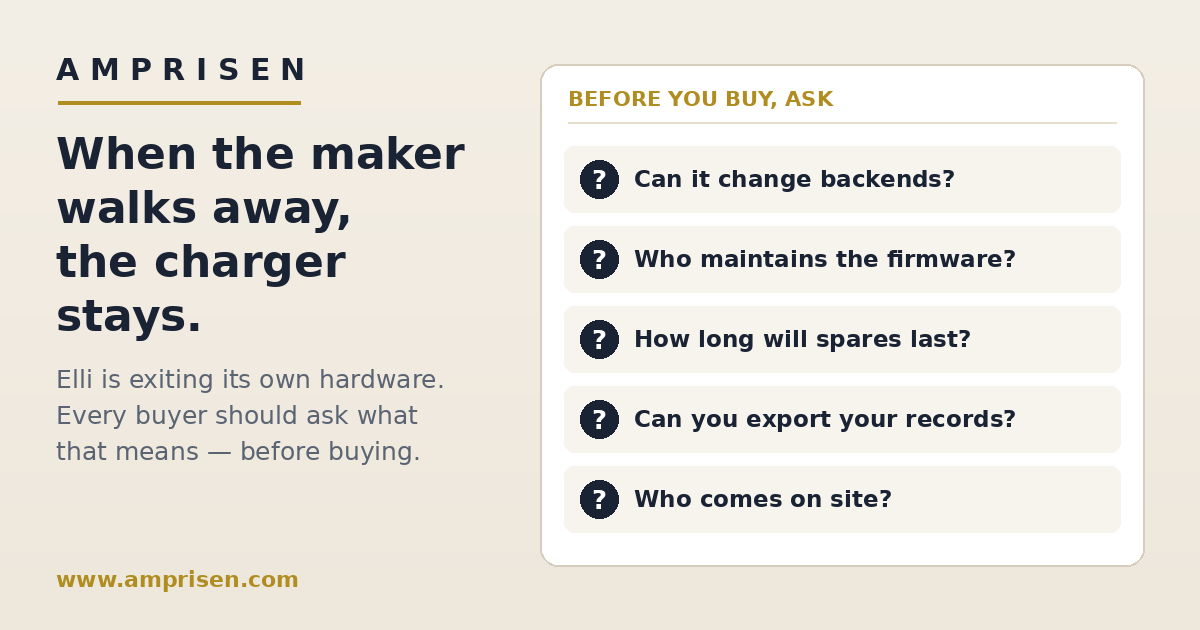
On 3 November 2026, electrive ran a story that deserves more than a skim. Elli, the Volkswagen Group’s charging subsidiary, is getting out of hardware. Its own AC wallbox is being wound down: sell what’s in stock, then no new orders. Flexpole fast charger production in Hanover ends. Fleet charging sites — planning, construction, maintenance — go to external partners, done by the end of 2027. What remains is digital: fleet management, charging cards and apps, energy, organised as Mobility and Energy, and the door is open to outside investors.
Nobody collapsed. CEO Giovanni Palazzo told electrive the move is about scalability, not sales trouble or technical problems, and he expects the industry to consolidate further. If you own an Elli charger, his message was blunt: nothing changes — not use, not service, not maintenance. Believe him. We do.
But read the story twice and a different point surfaces, one that has nothing to do with Elli. A wallbox is bought for years. A corporate strategy lasts until the next board meeting. Everything below follows from that gap — five questions, all of them boring, all of them worth asking before you sign anything — while walking away is still free.
First: could it run without its maker?
Backends get discontinued. They get repriced, too, or wound up quietly, which is the usual way. When yours goes, does the charger still charge?
An OCPP-speaking unit can be pointed at a different backend and it carries on working; that’s the entire point of an open protocol. A unit locked inside its maker’s closed system can’t. You haven’t bought it, in that case. You’ve rented it, and the landlord sets the terms. So the questions are plain enough. Is the protocol a standard one? Can the backend be changed by you, in practice and not just in a brochure? And who is allowed to make the switch — you, your installer, or only the manufacturer, at their pace?
Firmware, of all things
Our favourite question is the dullest. Who maintains the firmware, and for how long?
Firmware sounds like a footnote until you remember what rides on it: bug fixes, security patches, chunks of protocol behaviour. And when a model line dies, firmware maintenance is typically the first thing to stop — first, and quietly. Pin the period down. Ask, too, whether updates arrive over the air or mean a technician driving out each time. Then get it into the purchase documents, because paper has a longer memory than a sales call.
Spares
Short section, because the point is short. Chargers live in garages and car parks, not showrooms; cables get driven over, connectors get knocked, units wear out. How long after a model is discontinued will parts, or a like-for-like replacement, still be around? If the model is gone, can another unit take its place on the same backend, or is the site rebuilt around the hole? One damaged charger should be a repair job. Bought badly, it is a write-off sitting in a garage.
Your data: can it leave with you?
In German company-car charging the wallbox is also a bookkeeping device. Sessions it records feed home-charging reimbursements, accounting, energy reports — the unglamorous paperwork fleets actually run on. Backends change all the same. Suppliers exit, contracts end, somebody finds a better service. On that day the records have to move.
Can they? Not in theory — actually. Exported in a format someone on your team can open. Still reachable once the contract’s done. Yours, unambiguously — not the platform’s. Data you can’t take with you is, in the end, a switching cost. Plenty of buyers never ask about it — and then a contract ends, and they find out what they actually own.
And when it breaks — who shows up?
Last one, and it’s about people rather than products. Elli handing installation and maintenance to partners fits where the industry is heading, and it can work well — a regional installer will usually outrun a distant head office. Provided somebody’s name sits next to each job before anything breaks. Someone planned the site; someone maintains it; a driver whose car didn’t charge rings someone at six in the morning. Get those names now, and ask which of them survive the next restructuring. Leave it unnamed and the job lands, by default and always mid-crisis, on the fleet manager’s desk.
Where our own hardware fits — and the obvious caveat
Everything above cuts both ways, which is as it should be. If a supplier can’t pass these five questions, the size of its logo shouldn’t save it. That standard lands on us too.
We sell portable chargers, so discount what follows accordingly. The units were specced with this problem in mind, though. No wall, no fixed installation — they move with the driver. Connectivity is their own, built-in 4G, not whatever a basement garage happens to offer. They speak OCPP 1.6J, Smart Charging included, so the backend is a choice rather than a marriage. A meter is built in, and the session records come out in exportable form, because reimbursement paperwork is where fleets actually live. None of it abolishes supplier risk — suppliers pivot, and we might — it just means a pivot strands less.
The short version
Exits like Elli’s will keep happening, and they’ll keep looking like this: orderly, announced, reasonable. Also awkward, if you bought on logo alone.
So, the homework. Before the next order, five answers in writing, however the supplier wants to phrase them: the charger runs an open protocol and the backend can be changed; firmware gets maintained until a date somebody will actually name; spares exist for a stated stretch of years; the session data is exportable and stays yours; a named human or firm owns installation and site service. Suppliers who answer all that cleanly are selling chargers. The rest are selling dependency. Better to know which you’re buying before the invoice lands, not after.
Explore related EV charging topics
These topic links help readers and search engines connect this article with related market, product, and application pages.
Project notes for EV charging buyers
EV charging project notes and buyer guidance
Use this article to understand product selection, market standard, and project requirements before contacting Amprisen.
Main topic
EV charger market and product insight
Product relevance
Related news category: Industry News
Next step
Share target market, connector standard, power range, quantity, certification, and backend requirements before quotation.
Buyer checklist
| Market | Residential, commercial, fleet, or public charging |
|---|---|
| Specification | Connector, power, communication, certification |
| Outcome | A clearer product shortlist and quotation request |
Related solution pages
Use these links to move from article context to actual product evaluation.