
DC Fast Charger Commissioning Checklist for Fleet and Public Charging Sites

Short answer
A DC fast charger should be commissioned only after the buyer, installer, backend provider, and supplier confirm the site power supply, protection devices, grounding, connector mix, charging power, cable reach, emergency stop, cooling, network, OCPP backend, payment or RFID workflow, meter values, fault reporting, maintenance access, spare-parts route, and handover documents. The final result should be a written commissioning record with pass/fail items, photos, test sessions, backend screenshots, unresolved issues, responsible owner, and sign-off before public or fleet operation starts.
Why commissioning matters for DC fast charger projects
DC fast charger projects carry more risk than a simple product delivery. The charger, transformer capacity, distribution cabinet, cable route, parking layout, network, OCPP backend, user authorization, payment workflow, safety devices, and service plan all have to work together before the site can reliably serve drivers.
For fleet depots, retail parking, highway service areas, charging operators, and commercial landlords, commissioning is the step that proves the hardware is ready for real operation. A charger that powers on is not automatically ready for public use. Buyers should confirm that the charger can start and stop sessions, report correct data, handle faults, communicate with the backend, and be serviced without blocking site operation.
The commissioning checklist should be agreed before shipment or installation. This helps the buyer compare suppliers by readiness, not only by charger price.
Define the site operation model first
The commissioning plan depends on how the site will operate.
For a fleet depot, the main goals may be scheduled charging, RFID driver identification, daily kWh reports, uptime, and fast fault response. For public charging, the buyer may need payment, QR or app authorization, screen language, tariff display, customer support, remote monitoring, and clear fault handling. For dealership or service-station charging, the charger may need simpler authorization but strong service access and safe cable handling. For corridor or destination charging, connector availability, cable reach, lighting, signage, and backend visibility become important.
Before testing the charger, write down the target power level, connector standard, user group, authorization method, OCPP platform, payment route, support owner, and acceptance criteria.
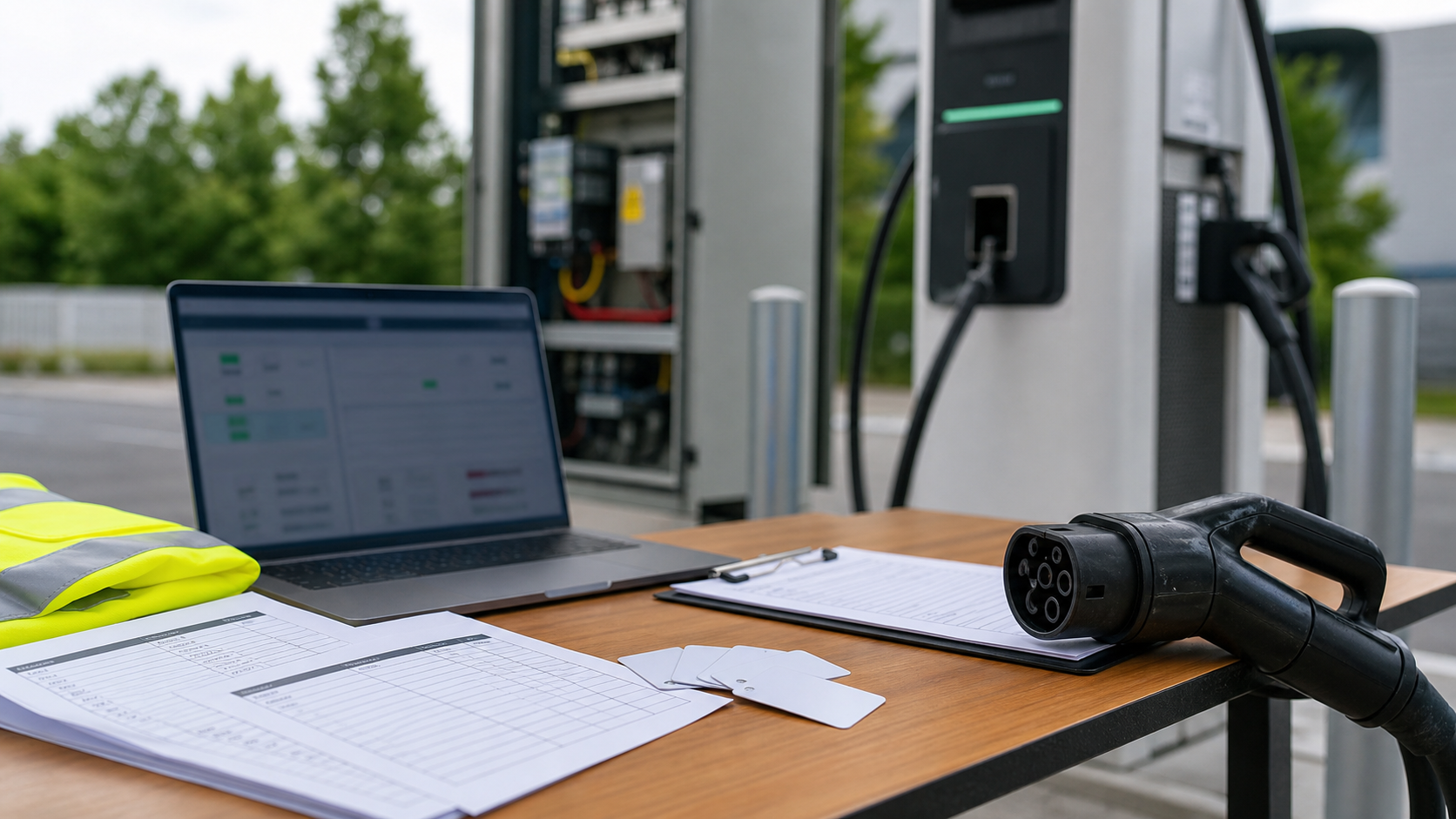
DC fast charger commissioning checklist
| Commissioning area | What to verify | Evidence to keep | Buyer risk if skipped |
|---|---|---|---|
| Site power supply | Transformer capacity, distribution cabinet, breaker, cable size, voltage, phase, grounding | Installer notes, panel photos, electrical test sheet | Charger may derate, trip, or fail local acceptance |
| Charger configuration | Rated power, module count, output limit, language, time zone, charger ID | Configuration screenshot, label photo | Backend and service records may not match the physical charger |
| Connector mix | CCS1, CCS2, CHAdeMO, GBT, cable length, parking reach, connector holder | Connector photos, vehicle test list | Drivers may be unable to use the charger conveniently |
| Protection and safety | Emergency stop, insulation monitoring, RCD or leakage strategy where applicable, surge protection, earthing | Safety test record, installer sign-off | Safety responsibility and fault handling remain unclear |
| Cooling and environment | Fan or cooling behavior, ventilation space, dust/rain exposure, sunlight, drainage | Site photos, thermal notes | High-temperature operation may reduce power or cause downtime |
| Network | Ethernet, 4G, SIM, signal strength, firewall, reconnect behavior | Network test result, SIM details | OCPP, payment, and remote diagnosis may fail |
| OCPP backend | Boot notification, heartbeat, remote start/stop, status notification, meter values, fault reporting | Backend screenshots, OCPP test log | Operator cannot monitor or control the site reliably |
| Authorization | RFID, app, QR, plug-and-charge, payment terminal, staff card rules | Test session records | Users may be unable to start sessions or may charge without control |
| Charging performance | Start/stop, ramp-up, output limit, vehicle compatibility, multi-connector behavior | Test session report by vehicle | Site may launch with hidden compatibility problems |
| Metering and records | kWh, session ID, user ID, charger ID, start/stop time, export format | CSV/export sample, backend screenshots | Billing, reimbursement, or fleet accounting may be disputed |
| Fault handling | Network loss, emergency stop, connector error, power recovery, backend retry | Fault test notes | Operators may not know what happens during real failures |
| Service access | Door clearance, module access, cable replacement, spare parts, maintenance contact | Photos, spare-parts list | Downtime and service cost increase after launch |
| Handover documents | Manual, wiring diagram, certificate list, OCPP settings, warranty, maintenance process | Signed handover package | Buyer receives hardware but not an operating system |
Confirm the electrical acceptance before software testing
Software testing should not start until the electrical installation is accepted by the installer or qualified project owner. The buyer should confirm that supply voltage, grounding, cable size, breaker selection, protection devices, torque checks, cabinet ventilation, and emergency stop wiring match the project design.
For high-utilization DC sites, the installer should also confirm whether the site has enough upstream capacity for the planned charging pattern. A 60 kW charger used occasionally has a different grid impact from a 120 kW or 180 kW site serving fleets throughout the day. If the charger will be power-limited at launch, record the configured limit and the reason.
The commissioning record should separate electrical acceptance from charger operation acceptance. This keeps supplier, installer, and site-owner responsibility clear.
Test connector behavior with real vehicles where possible
A DC fast charger may support the right connector standard on paper, but the buyer should still test real charging sessions. Use the vehicle types expected at the site, such as CCS2 fleet vans, CCS1 vehicles, CHAdeMO legacy users, or GBT vehicles depending on the target market.
For each connector, record the vehicle model if available, connector used, start method, peak power, session duration, kWh delivered, stop method, error messages, and whether the backend received the correct data. If the site has two DC connectors, test whether one connector and simultaneous connector behavior match the purchased configuration.
Cable reach also matters. A charger installed in the wrong position can pass a technical test but fail daily operation because the cable cannot reach the charge port comfortably.
OCPP commissioning should be more than a connection test
For commercial DC charging, OCPP is usually part of the operating system. A simple “online” status is not enough. The commissioning test should confirm charger identity, boot notification, heartbeat interval, status notifications, remote start, remote stop, transaction events, meter values, fault reporting, firmware or configuration visibility, and reconnect behavior after network interruption.
The buyer should keep screenshots from the backend and export a short test log. At minimum, the record should show that the charger can start a session from the backend, stop a session from the backend, report kWh, report connector status, recover after a short network interruption, and show a useful fault state when a controlled fault is tested.
If the operator uses a payment or app platform, OCPP testing should include the real authorization route, not only an engineering test card.
Payment, RFID, and user records must match the business model
DC fast chargers often serve multiple user types: public drivers, fleet drivers, staff, VIP customers, service technicians, or test users. The buyer should define these groups before launch.
For public charging, verify QR code, app, card, payment terminal, tariff display, receipt or record flow, and customer support path. For fleet charging, verify RFID cards, driver or vehicle IDs, report export, monthly summary, and permission rules. For semi-private commercial sites, verify whether the charger is open to all users, limited to registered users, or controlled manually by staff.
The commissioning record should include sample session records. Useful fields include charger ID, connector ID, user ID, authorization method, start time, stop time, kWh, charging duration, stop reason, and payment or account status where applicable.
Check thermal behavior, ventilation, and service access
DC fast chargers depend on stable heat management. During commissioning, observe fan behavior, cabinet ventilation, air path, temperature warnings, dust exposure, direct sunlight, rain protection, drainage, and service clearance.
The site should allow technicians to open the cabinet, replace modules or key components, inspect cable strain, access filters where used, and work safely without blocking all charging bays. If the charger is installed near traffic, confirm bollards, curb position, cable management, lighting, and pedestrian safety.
For buyers comparing suppliers, service access and spare-parts availability can be as important as peak charging power. Ask for the spare-parts list, warranty scope, failure reporting workflow, firmware support policy, and expected response route before opening the site.
Recommended Amprisen planning path
Buyers planning a DC charging project can start with Amprisen’s DC EV charger range, then use the existing planning guides to prepare the commissioning file:
- Review the DC EV Charger category.
- Review the DC fast charger site-planning guide.
- Review the OCPP buyer guide before backend testing.
- Compare AC and DC site fit for commercial parking.
- Use the contact page for project details and files.
- Use Downloads for datasheets and support material where available.
The strongest DC charger inquiry includes target country, site type, available transformer or grid capacity, desired charger power, connector mix, number of bays, installation layout, OCPP backend, payment or RFID workflow, network method, certification needs, service expectations, and launch timeline.
Pre-launch handover package
Before the site opens, the buyer should ask for one complete handover package:
- Final model and configuration list.
- Charger serial number, charger ID, connector ID, and firmware version.
- Installation photos and electrical acceptance notes.
- OCPP backend settings and backend test evidence.
- Payment, RFID, app, or QR authorization test records.
- Charging session records for each connector.
- Emergency stop and controlled-fault test notes.
- User manual, installation manual, wiring diagram, and certificate list.
- Spare-parts list, warranty terms, and after-sales contact process.
- Open-issue list with owner and due date.
Commissioning is complete only when the open items are accepted by the buyer or assigned to a responsible owner with a deadline.
FAQ
Is DC fast charger commissioning necessary if the charger already passed factory testing?
Yes. Factory testing checks the charger before shipment, but commissioning checks the real site: grid supply, installation quality, connector reach, network, OCPP backend, payment or RFID workflow, records, and service access.
What should buyers test first during commissioning?
Start with electrical acceptance and site safety. Then test charger configuration, connector behavior, network, OCPP, authorization workflow, charging sessions, fault handling, and handover documents.
Should OCPP be tested before the site opens?
Yes. For commercial and fleet DC sites, OCPP should be tested with real charger identity, heartbeat, remote start and stop, status notifications, meter values, fault reporting, and reconnect behavior.
How many charging sessions should be tested?
At minimum, test every connector and every intended authorization route. For public or fleet sites, it is better to test multiple vehicles or user profiles so hidden compatibility and record issues are found before launch.
What is the most common handover risk for DC charger projects?
The common risk is split responsibility. The hardware supplier, installer, backend provider, payment provider, and site owner may each assume another party is responsible for records, fault response, or user support. A written commissioning record reduces that risk.
Does a higher power DC charger always create a better site?
No. Higher power only helps when the site has enough grid capacity, suitable vehicles, enough utilization, correct cooling, safe layout, and an operating model that justifies the installation and service cost.
Recommended internal links
Review DC EV Charger, DC Fast Charger Site Planning, What Is OCPP EV Charging?, Commercial Parking EV Charging: Choose AC or DC Chargers, Charging Cable Selection Guide, Downloads, and Contact.
Explore related EV charging topics
These topic links help readers and search engines connect this article with related market, product, and application pages.
Project notes for EV charging buyers
EV charging project notes and buyer guidance
Use this article to understand product selection, market standard, and project requirements before contacting Amprisen.
Main topic
B2B Buyer Guide, DC Fast Charger, EV Charger Commissioning, EV Infrastructure, Fleet Charging, OCPP, Public Charging
Product relevance
Related news category: Industry News
Next step
Share target market, connector standard, power range, quantity, certification, and backend requirements before quotation.
Buyer checklist
| Market | Residential, commercial, fleet, or public charging |
|---|---|
| Specification | Connector, power, communication, certification |
| Outcome | A clearer product shortlist and quotation request |
Related solution pages
Use these links to move from article context to actual product evaluation.