
AC EV Charger Site Survey Checklist for Commercial Projects
Short answer
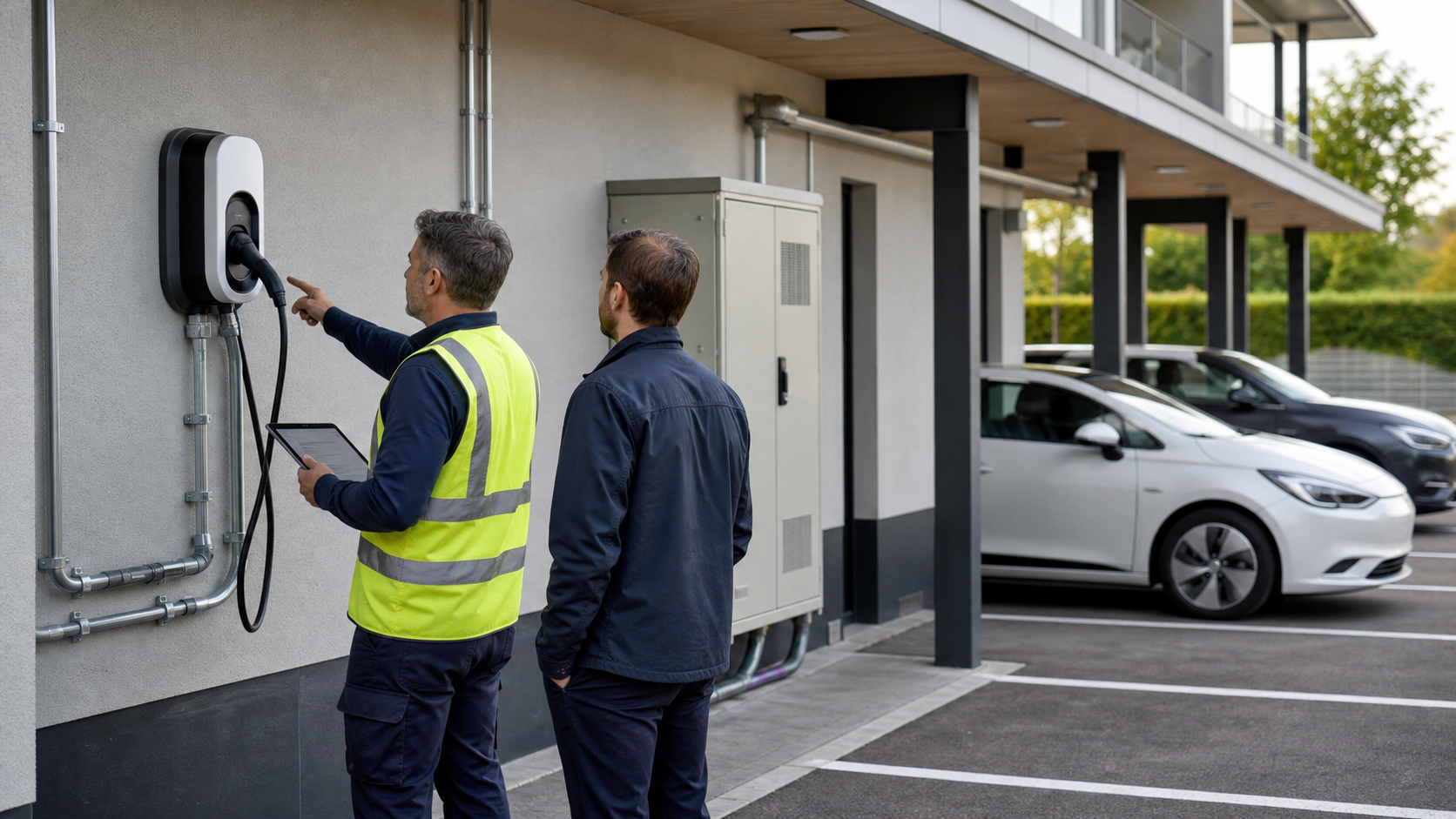
A commercial AC EV charger site survey should confirm the target country, building type, available supply, phase, breaker and RCD plan, earthing, mounting position, cable route, IP/IK environment, charger quantity, 7 kW/11 kW/22 kW power plan, network signal, OCPP backend need, RFID or app access, Dynamic Load Balancing, MID or charging-record requirement, installer documents, and maintenance access before the buyer requests a final quotation. The output should be a written survey sheet, photos, single-line electrical notes, and a clear list of open items.
Why the site survey should happen before quotation
Many commercial AC EV charging problems start before the charger is shipped. The buyer may choose the correct-looking wallbox, but the site later reveals limited capacity, unclear earthing, weak network signal, a difficult cable route, no space for maintenance, or an operating model that needs OCPP and user records.
For distributors, installers, hotel owners, apartment operators, workplaces, and fleet sites, the site survey connects product selection with real installation conditions. It helps the buyer decide whether the project needs 7 kW single-phase chargers, 11 kW or 22 kW three-phase chargers, socket or tethered cable output, RFID, app control, OCPP, Dynamic Load Balancing, MID metering, or a simpler private-use configuration.
Before comparing bulk price, the buyer should collect site information in a standard format. A low-cost charger can become expensive if the installation design, protection plan, documentation, and operating workflow are unclear.
Define the charging use case first
The first survey question is not only “how many chargers do we need?” It is “who will use them, how will access be controlled, and who will maintain the site?”
For workplace charging, the operator may need staff access rules, RFID cards, monthly reports, and a simple maintenance process. For apartment charging, the project may need user-level records, load management, and clear rules for shared electrical capacity. For hotel and destination parking, the site may need QR or app authorization, customer support, and remote monitoring. For fleet depots, charger uptime, session records, and repeatable operation can matter more than exterior design.
The buyer should write the use case before selecting the model. This prevents a private wallbox from being quoted for a commercial project that actually needs backend control and records.
Site survey checklist
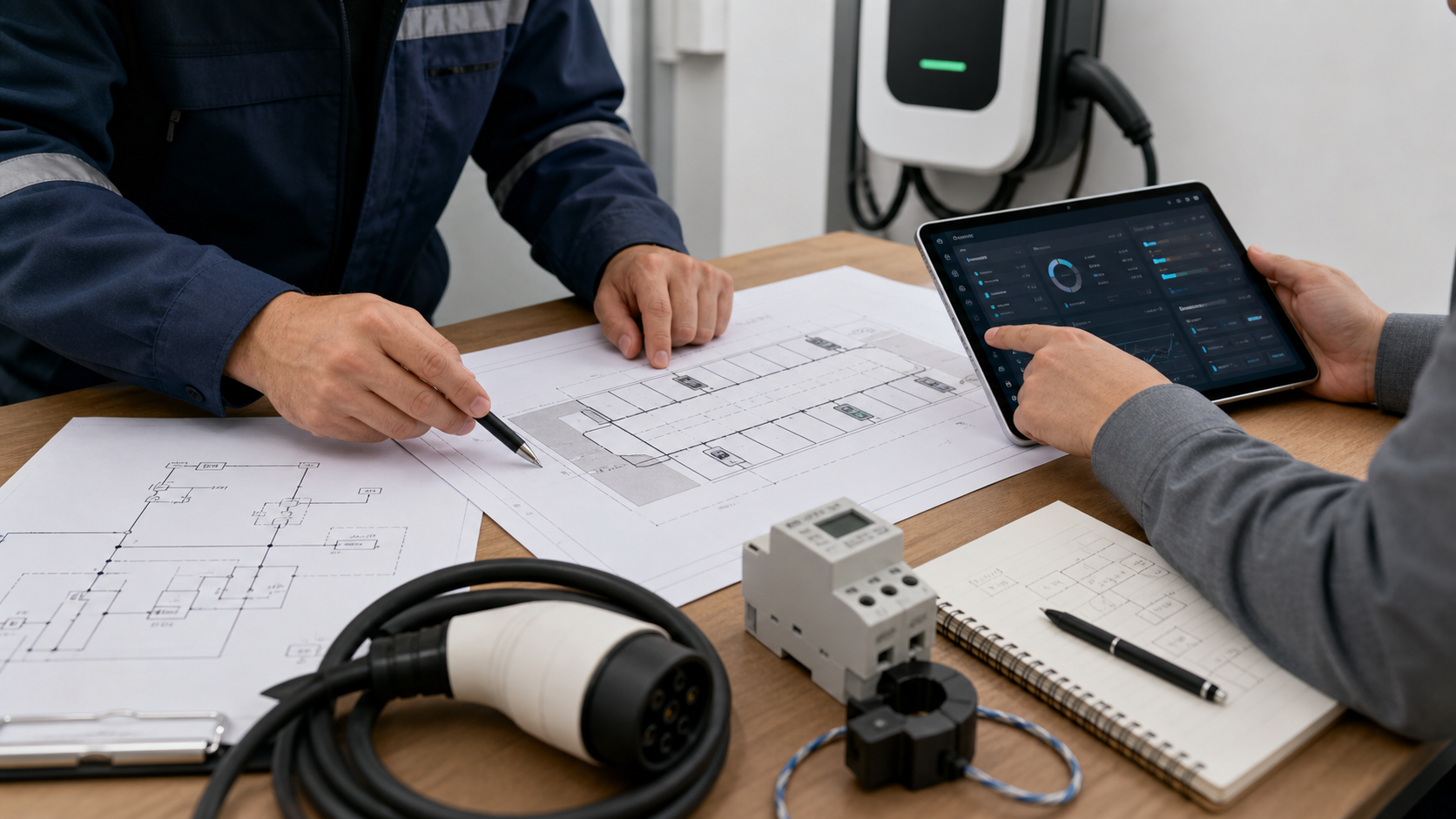
| Survey area | What to check | Buyer risk if skipped |
|---|---|---|
| Target market | Country, grid voltage, phase, connector standard, language, compliance route | Product may not match local installation or resale expectations |
| Electrical capacity | Available amperage, existing load, panel space, single-phase or three-phase supply | Charger power may exceed the real site capacity |
| Power level | 7 kW, 11 kW, 22 kW, adjustable current, future expansion plan | Buyer may over-order power that the site cannot support |
| Protection plan | Breaker, RCD type expectation, DC leakage protection, surge plan, earthing | Installer approval and safety responsibility become unclear |
| Mounting location | Wall or pedestal, indoor or outdoor, sunlight, rain, drainage, impact risk | Housing, IP rating, cable route, or user access may be wrong |
| Cable route | Distance from panel, conduit path, trenching need, cable size, voltage drop | Installation cost may exceed the product budget |
| Connector format | Type 1 or Type 2, socket or tethered cable, cable length, holder position | End users may face poor fit or inconvenient operation |
| Network | WiFi, Ethernet, 4G signal, SIM plan, basement or garage coverage | OCPP and remote monitoring may fail after installation |
| Access control | Plug-and-charge, RFID, app, QR, operator backend, guest access | Site operator may not control who can charge |
| Dynamic Load Balancing | CT clamp or meter position, charger group size, current limit logic | Shared capacity may be overloaded or underused |
| MID and records | MID need, kWh record, user ID, charger ID, timestamp, export method | Billing or reimbursement evidence may be insufficient |
| Maintenance access | Service clearance, cable replacement, firmware update, spare parts route | Downtime and after-sales cost increase |
| Documentation | Datasheet, installation guide, wiring notes, certificates, label language | Distributor and installer support becomes slow |
Electrical capacity decides the real charger mix
AC charger selection should start with the available supply. A 22 kW three-phase charger is not automatically the best choice if the site cannot support the current, if the vehicles usually park for many hours, or if multiple chargers share one panel.
For commercial sites, check the main supply, existing building load, spare breaker space, distance to parking bays, earthing condition, and whether future chargers are planned. If the site will start with two chargers and later expand to ten, the survey should document both the first phase and the expansion path.
Adjustable current can help, but it is not a replacement for proper electrical planning. The buyer should ask the installer to confirm whether the charger rating, cable size, protection devices, and site capacity are aligned.
OCPP should match the operating workflow
OCPP is useful when the operator needs remote monitoring, RFID or app authorization, charging records, fleet reporting, payment workflow, or multi-site management. It should be specified during the site survey because OCPP depends on network availability, backend selection, charger identity, authorization rules, and support responsibility.
For sample or pilot sites, buyers should test the actual backend connection before bulk order. A practical OCPP test record should include charger model, firmware version, network method, backend URL, charger ID, heartbeat, remote start and stop, meter values, fault reporting, reconnect behavior, and unresolved items.
If the project does not need remote operation, a simpler charger configuration may be enough. The survey should make this clear so the buyer does not pay for unused functions or miss functions that the operator needs later.
Dynamic Load Balancing needs a measurement point
Dynamic Load Balancing is often requested for apartments, workplaces, and shared parking, but it needs site-specific information. The survey should identify where the site load is measured, whether the project uses CT clamps or a meter, how many chargers are in the group, and what current limit should be maintained.
The buyer should also define behavior during high building load, power loss, network interruption, and charger expansion. If several chargers will share capacity, the project should clarify whether priority rules, user groups, or backend charging profiles are required.
MID and charging records depend on the business model
Not every AC charging project needs MID metering, but projects involving billing, reimbursement, tenant allocation, or fleet accounting should decide early. The site survey should ask whether the buyer needs only basic kWh display, backend charging records, user-level exports, or MID-related documentation.
For commercial operation, useful records usually include charger ID, user ID, session start and stop time, kWh, authorization method, and export format. The survey should connect these records to the operator’s real workflow.
Installation environment affects product configuration
A charger installed in an indoor private garage has different requirements from a semi-outdoor hotel parking area or a public workplace car park. The survey should record rain exposure, direct sunlight, dust, drainage, impact risk, wall strength, cable strain, pedestrian flow, vehicle turning space, and service access.
For outdoor or semi-outdoor use, confirm IP rating expectations, IK impact expectations where relevant, cable holder position, label durability, and whether a pedestal is needed. For branded distributor projects, the survey should also confirm label language, packaging, manuals, and accessory requirements before bulk production.
Recommended Amprisen planning path
Buyers comparing AC charger options can start with Amprisen’s AC EV charger range, then narrow the model by use case:
- For standard wall-mounted AC charging, review the AC EV Charger category and AC EV Charger Wallbox Series.
- For commercial sites that need backend operation, review the MONTA OCPP AC Charger Series and define OCPP test requirements.
- For apartment or workplace load control, review the Dynamic Load Balancing explainer before confirming the measurement method.
- For billing or reimbursement workflows, review the MID metering guide before choosing the charger and backend record format.
The strongest inquiry includes target country, site type, number of parking bays, available power, phase, desired charger power, connector type, installation environment, OCPP need, load balancing need, metering need, branding, quantity plan, and required documents.
Pre-quotation documents buyers should send
- Site photos showing panel, parking bays, wall or pedestal location, cable route, and network environment.
- Basic electrical notes including voltage, phase, spare capacity, breaker plan, and distance to chargers.
- Charger quantity plan for the first phase and possible expansion.
- Required functions such as RFID, app, OCPP, 4G, Ethernet, Dynamic Load Balancing, MID, or reports.
- Target country and documentation needs, including labels, manuals, certificate list, and installation guide language.
- Branding and packaging requirements if the order is for distributor resale.
- Open questions for the supplier, installer, and backend provider.
FAQ
Is a site survey necessary for a small AC EV charger project?
Yes. Even a small commercial project should confirm supply, phase, protection plan, mounting location, cable route, network, documents, and maintenance access. The survey can be simple, but it should be written.
Should buyers choose 7 kW, 11 kW, or 22 kW before the survey?
No. The buyer can have a target power level, but the final choice should depend on available capacity, phase, parking duration, vehicle mix, quantity, and expansion plan.
When does an AC charger site need OCPP?
Use OCPP when the operator needs remote monitoring, RFID or app authorization, charging records, payment workflow, fault visibility, fleet reporting, or multi-site management.
Does Dynamic Load Balancing remove the need for electrical planning?
No. Dynamic Load Balancing helps manage current, but the site still needs correct supply, protection, measurement point, installation design, and commissioning.
Does every commercial charger need MID metering?
No. MID depends on the market and business model. Sites involving billing, reimbursement, tenant allocation, or auditable charging records should check MID requirements before selecting hardware.
What should an installer confirm before bulk ordering?
The installer should confirm electrical capacity, protection plan, cable route, mounting method, charger position, network availability, DLB setup if used, commissioning process, and local compliance documentation.
Recommended internal links
Review AC EV Charger, AC EV Charger Wallbox Series, MONTA OCPP AC Charger Series, What Is OCPP EV Charging?, What Is Dynamic Load Balancing for EV Chargers?, What Is MID Metering in EV Charging?, and Downloads.
Explore related EV charging topics
These topic links help readers and search engines connect this article with related market, product, and application pages.
Project notes for EV charging buyers
EV charging project notes and buyer guidance
Use this article to understand product selection, market standard, and project requirements before contacting Amprisen.
Main topic
AC EV Charger, B2B Buyer Guide, Commercial Charging, Dynamic Load Balancing, EV Charger Installation, EV Infrastructure, MID Metering, OCPP
Product relevance
Related news category: Industry News
Next step
Share target market, connector standard, power range, quantity, certification, and backend requirements before quotation.
Buyer checklist
| Market | Residential, commercial, fleet, or public charging |
|---|---|
| Specification | Connector, power, communication, certification |
| Outcome | A clearer product shortlist and quotation request |
Related solution pages
Use these links to move from article context to actual product evaluation.