
Portable Type 2 EV charger buying guide: Mode 2, power, OCPP and EU export checks
Short answer: A portable Type 2 EV charger is a Mode 2 device. It plugs into a household or industrial socket and carries its own control and protection box in the cable. Buy it for vehicles that charge at sites without a wallbox, or where a fixed installation is slow or not allowed. Size it by the sockets you will actually find at those sites and by the AC power the vehicles accept. If the vehicles park in the same place every night and a wallbox can be installed there, buy a wallbox instead.
In this guide
What makes a charger “Mode 2”
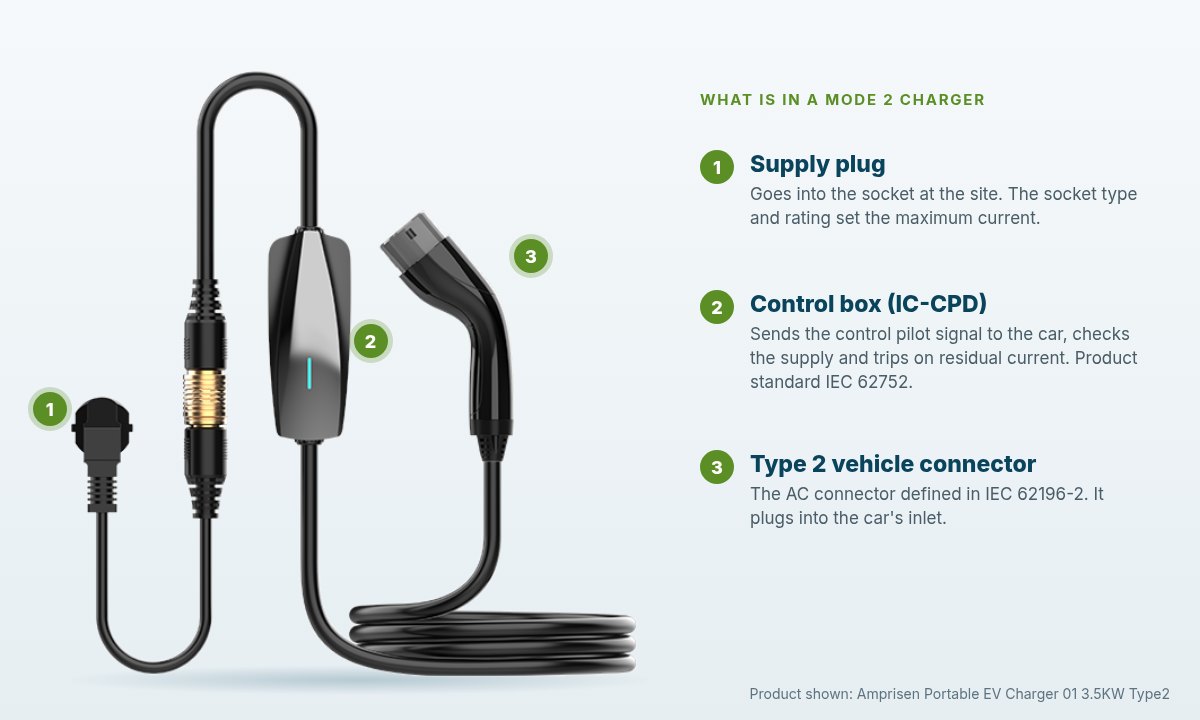
IEC 61851-1 defines four charging modes. Mode 2 connects the vehicle to a standard socket-outlet, single-phase or three-phase, with a control pilot conductor between the vehicle and a control box in the cable. The standard limits Mode 2 to 32 A, at up to 250 V on single-phase and 480 V on three-phase supplies.
The box in the cable is the in-cable control and protection device (IC-CPD), and IEC 62752 is its product standard. The IC-CPD sends the control pilot signal that tells the car how much current it may draw. It checks the supply before switching on and disconnects when it detects residual current. Mode 2 needs this box because the driver usually cannot know whether the socket’s circuit has suitable RCD protection.
At the vehicle end, a portable Type 2 charger uses the connector defined in IEC 62196-2. It is the same AC interface found on European wallboxes and public AC charge points.
Portable Mode 2 charger or wallbox?
A wallbox is Mode 3 equipment. An electrician wires it to a dedicated circuit, and the control and protection functions sit in the fixed unit. A portable unit carries those functions with it and relies on whatever socket it is plugged into. The table compares the two from a buyer’s side.
| Question | Portable Mode 2 charger | Wallbox (Mode 3) |
|---|---|---|
| Where control and protection sit | In the control box on the cable | In the fixed charging unit |
| Installation | None for the charger. The socket and its circuit must suit the load. | Installed by an electrician on a dedicated circuit |
| Current limit | 32 A under IEC 61851-1 | Set by the charger and its circuit |
| Supply connection | Household socket, or a blue or red industrial CEE socket (IEC 60309) | Hard-wired |
| Moves between sites | Yes | No |
| Shared load across several chargers | Each unit only sees its own socket unless a backend manages it | Can share a site limit through a site controller or backend |
| Best fit | Fleets that change sites, temporary sites, rental cars, backup charging | Fixed parking used every day |
Choose a wallbox instead of a portable unit in these cases:
- The vehicles return to the same parking spaces every night, and the site owner allows an installation.
- Several vehicles charge at one site and the total load has to stay within the grid connection. See dynamic load balancing.
- Charging is sold to third parties or billed per session, and the buyer needs a meter approved for billing.
Amprisen also supplies wall-mounted units in the AC wallbox series.
Single-phase or three-phase: choosing power
AC charging power is phase voltage times current times the number of phases. In most of Europe the phase voltage is 230 V and the voltage between phases is 400 V. The table shows what each common supply gives.
| Supply | Approx. power | Socket you need |
|---|---|---|
| Single-phase, 16 A | 3.7 kW (230 V × 16 A) | Household socket rated 16 A, or blue CEE 16 A |
| Single-phase, 32 A | 7.4 kW (230 V × 32 A) | Blue CEE 32 A on a 32 A circuit |
| Three-phase, 16 A | 11 kW (3 × 230 V × 16 A) | Red five-pin CEE 16 A |
| Three-phase, 32 A | 22 kW (3 × 230 V × 32 A) | Red five-pin CEE 32 A |
The car takes the lowest of three limits: the socket and its circuit, the current the charger signals, and the vehicle’s onboard charger. Many cars accept 11 kW on three-phase AC. Fewer accept 22 kW, and some charge on one phase only. Check the AC charging power and the number of phases on each vehicle’s data sheet before you pay for a 22 kW unit. A 22 kW charger on a car limited to 11 kW charges at 11 kW.
Household sockets need care. A Schuko socket is rated 16 A, and a charging session holds a steady load for hours. Check the destination country’s wiring rules and the vehicle maker’s guidance on charging current from household sockets. At 3.7 kW, an eight-hour stop adds about 30 kWh at most.
Seven kilowatts on one phase needs 32 A, and no European household socket is rated for that. A 7 kW single-phase unit therefore needs a blue 32 A CEE socket on a matching circuit. Three-phase units need a red five-pin CEE socket with three phases, neutral and earth. They are more common in workshops, depots and on construction sites than in homes.
Amprisen Type 2 portable models
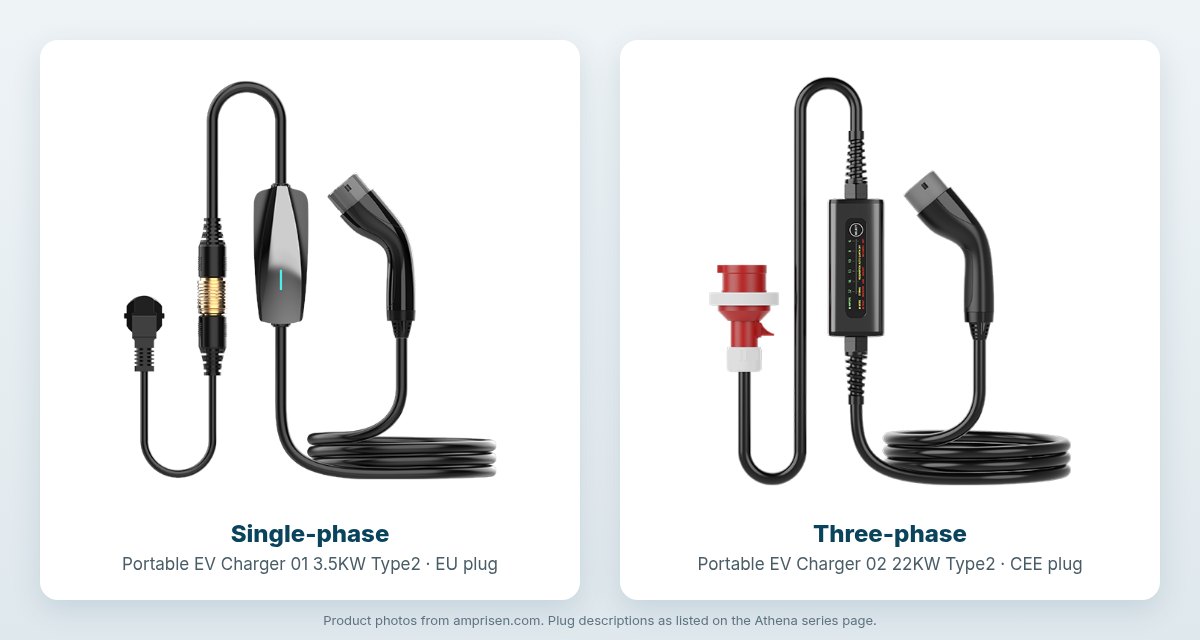
The ratings below are copied from the Amprisen product pages. The 01, 02 and 03 numbers refer to the control box housing (case) design.
| Model | Rating on the product page | Input voltage on the product page |
|---|---|---|
| Portable EV Charger 01 3.5KW Type2 | Single phase up to 3.5kW/16A | 230 V ±20%, single phase, 50 Hz |
| Portable EV Charger 01 7KW Type2 | Single phase up to 7kW/32A | 230 V ±20%, single phase, 50 Hz |
| 01, 02 and 03 three-phase 16 A Type2 | Three phase up to 11 kW/16A | 380 V ±20%, three phase, 50/60 Hz |
| 02 and 03 22KW Type2 | Three phase up to 22kW/32A | 380 V ±20%, three phase, 50/60 Hz |
All seven Type 2 product pages list the same core data:
| Charging mode | Mode 2 |
|---|---|
| Network type | TT, TN |
| Internal RCD | AC 30 mA, DC 6 mA |
| Vehicle connector | IEC 62196 Type 2, 5 m cable |
| IP and IK rating | IP65, IK10 (screen IK08) |
| Operating temperature | -20 °C to +55 °C |
| Connectivity | Bluetooth, Wi-Fi |
| User interface | Easy Charging APP, Easy Charging Cloud |
| Certification | CE |
| Warranty | 24 months, extension possible |
Plugs, adapters and vehicle compatibility
A Type 2 connector fits the car, but the order can still be wrong at the supply end or in the grid. Run these checks per destination country.
| Check | What to confirm | Amprisen product data |
|---|---|---|
| Vehicle inlet | Type 2 is the standard AC inlet on cars sold in Europe. Imported vehicles may have Type 1 or GB/T inlets. | Type 2 and Type 1 versions are listed |
| Supply plug | The socket type and rating at every site | A 16 A single-phase unit can use a household plug. A 32 A single-phase unit needs an industrial plug such as blue CEE 32 A. Three-phase variants use a red CEE plug. Confirm the plug fitted to each model before you order. Amprisen fits the supply plug to the buyer’s market standard on request. |
| Earthing system | TN, TT or IT supply at the site | TT, TN |
| Frequency | 50 Hz in Europe | Single-phase: 50 Hz. Three-phase: 50/60 Hz |
| Cable length | Distance from the socket to the car’s inlet in a normal parking position | 5 m |
| Vehicle AC limit | Onboard charger power and number of phases | Depends on the vehicle |
IT grids. Many Norwegian homes are on a 230 V IT grid with no neutral conductor. Charging equipment used there must be approved by its maker for IT supplies. The Amprisen pages list TT and TN only, so do not plan IT-grid sites on these models unless Amprisen confirms IT compatibility in writing.
Vehicle-side adapters. IEC 61851-1 does not allow adaptors between the vehicle connector and the vehicle inlet. If a fleet includes Type 1 cars, order Type 1 units for them. A Type 2 unit with an adapter is the wrong product.
Supply-side plugs. Some portable kits ship with interchangeable supply plugs. Ask the supplier how the control box detects which plug is fitted and how it limits current to that plug’s rating. A 32 A setting running through a 16 A plug can overheat the plug. Do not use extension leads or travel adapters with any Mode 2 charger.
For non-European markets, our Type 1, Type 2 and GBT selection guide covers connector choice by region.
OCPP on a portable charger: what it does and who needs it
OCPP (Open Charge Point Protocol) is an open protocol maintained by the Open Charge Alliance. It connects a charger to a central management system run by a charge point operator or a fleet. Over OCPP the backend authorises sessions, starts and stops charging, receives status and meter values, changes settings and pushes firmware updates. Versions in use include OCPP 1.6 and OCPP 2.0.1. IEC published OCPP 2.0.1 as IEC 63584:2024, and the Open Charge Alliance released OCPP 2.1 in January 2025. The charger and the backend must support the same version.
A portable unit can only talk OCPP while it is online. A unit that moves between sites needs a network at each one, and a Wi-Fi unit needs Wi-Fi set up at every parking spot. Ask how the unit stores sessions that run while it is offline and when it sends them to the backend.
OCPP is worth paying for when a fleet or rental operator already runs a charging backend and wants portable units in the same system, with session records per driver or vehicle. A private driver or a small business that only needs to start, stop and schedule charging can do that from an app. Specifying OCPP for them adds setup work and cost.
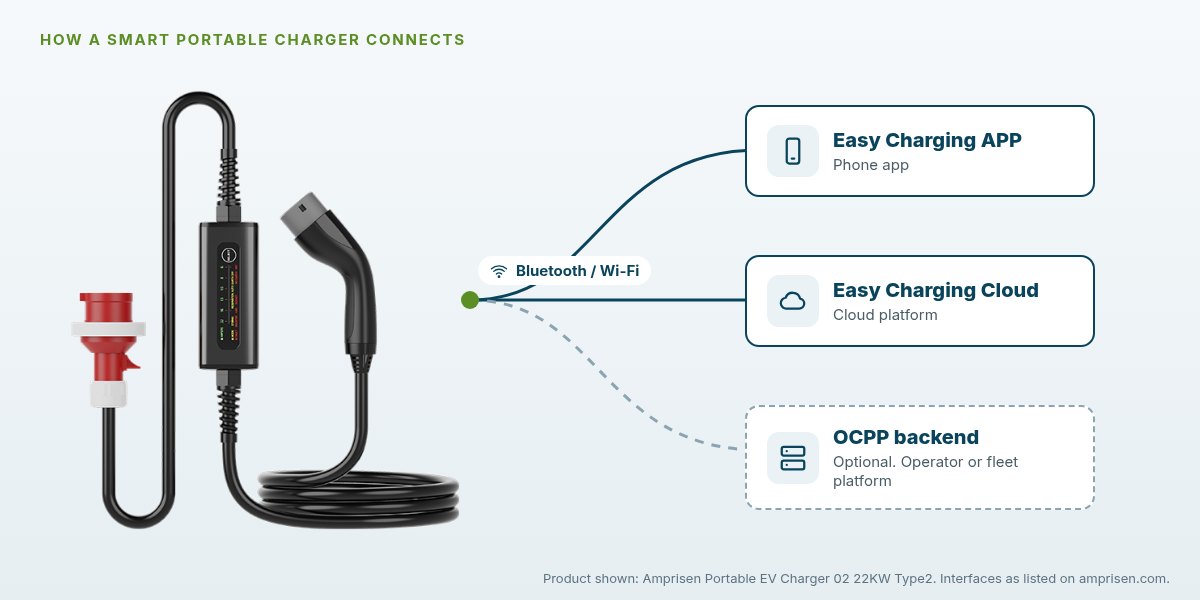
The Amprisen Type 2 product pages list Bluetooth and Wi-Fi connectivity, MQTT as the communication protocol, and the Easy Charging APP and Easy Charging Cloud as the user interface. The Athena series page lists communication as “App/OCPP optional”. Tell us your backend and the OCPP version it runs before quotation, and test a sample against it before a volume order. Our OCPP backend testing checklist lists what to test.
Metering is a separate question. OCPP carries meter values, but the protocol does not make a meter acceptable for billing. Whether billing needs a meter approved under the EU Measuring Instruments Directive (MID, 2014/32/EU) or under national calibration law, such as Eichrecht in Germany, depends on the country and the use. The Amprisen product pages list power measurement accuracy of ±1.0% from 1% to full scale and do not claim MID approval. If your project needs MID, say so in the inquiry.
Export checklist for EU markets
Collect these items before the first shipment to an EU country.
| Item | What to confirm | Reference |
|---|---|---|
| CE marking and EU Declaration of Conformity | The DoC names the exact model and lists the directives and harmonised standards applied | Units with Wi-Fi or Bluetooth are radio equipment under Directive 2014/53/EU (RED), which also covers their electrical safety and EMC. RoHS Directive 2011/65/EU applies as well. |
| Cybersecurity of connected units | Evidence that the unit meets the RED cybersecurity requirements, often through the EN 18031 series | Delegated Regulation (EU) 2022/30, applicable since 1 August 2025 |
| Mode 2 product standard | Test report for the control box of the exact model you order, named in the DoC | EN IEC 62752 |
| Vehicle connector | Type 2 connector to the IEC 62196-2 configuration | EN IEC 62196-2 |
| Compatibility labels | The graphical identifiers that tell drivers which vehicles the connector fits | EN 17186 |
| EU economic operator | An EU-based manufacturer, importer, authorised representative or fulfilment service provider, named on the product, packaging or documents | Regulation (EU) 2019/1020, Article 4 |
| WEEE | Producer registration in each EU country of sale and the crossed-out bin symbol on the product | Directive 2012/19/EU |
| Instructions | Manual and safety information in the language required by each destination country | RED, Article 10(8) |
| Plug variant | Supply plug and earthing system match each destination country | National wiring rules |
The Amprisen Type 2 product pages list CE and the EN standards applied to each model. Ask for the DoC and the test reports for the exact model and plug variant you order. Our certification guide explains how to read them.
When a portable Type 2 charger is the wrong product
- Daily charging at fixed parking. If a wallbox can be installed, it gives a dedicated circuit and no plug wear.
- Paid or public charging. Billing usually needs approved metering, and the Amprisen portable product pages do not claim MID.
- IT-grid sites. The product pages list TT and TN networks only.
- Vehicles limited to 11 kW AC. A 22 kW unit brings no extra speed for them, and it needs a 32 A three-phase socket.
- High daily mileage on household sockets. At 3.7 kW, an eight-hour stop adds about 30 kWh at most.
- UK projects. The UK uses BS 1363 plugs and its own wiring rules, which this guide does not cover.
Selection checklist before you send an inquiry
| What to confirm | Why it matters |
|---|---|
| Destination countries | Sets the plug variant, manual languages and labelling |
| Vehicle models | Their AC power and phases set the useful charger rating |
| Sockets at each site | Type, current rating and number of phases set the maximum power |
| Earthing system | IT grids need separate confirmation |
| Cable length | The listed cable is 5 m. Ask before planning longer runs. |
| App or OCPP | For OCPP, give the backend name and the OCPP version |
| Metering | State whether MID or a national approval is required |
| Branding and packaging | Logo, labels, manual, carry case |
| Quantity and schedule | Sample test first, then volume order |
FAQ
Is a portable Type 2 charger the same as a granny charger?
“Granny charger” is a UK nickname for a Mode 2 cable that plugs into a household socket. A portable Type 2 charger is the same kind of device. Higher-power units use industrial CEE plugs instead of household plugs.
Can a portable charger deliver 22 kW?
Yes, from a red 32 A three-phase CEE socket, if the car’s onboard charger accepts 22 kW AC. IEC 61851-1 allows Mode 2 up to 32 A, and 3 × 230 V × 32 A is about 22 kW. Amprisen lists two Type 2 models rated “Three phase up to 22kW/32A”.
Does the control box replace the RCD in the building?
No. The IC-CPD protects the cable and the vehicle side when nobody knows how the socket circuit is protected. The circuit feeding the socket still has to meet national wiring rules.
Can I charge a Type 1 car from a Type 2 portable charger with an adapter?
No. IEC 61851-1 does not allow adaptors between the vehicle connector and the vehicle inlet. Order the Type 1 version. Amprisen lists Type 1 variants in the Athena series.
Do Amprisen portable chargers support OCPP?
The Athena series page lists communication as “App/OCPP optional”. Give us your backend and OCPP version so we can confirm the configuration and send a sample for testing.
Do the chargers have MID-approved meters?
The product pages do not claim MID approval. They list power measurement accuracy of ±1.0% from 1% to full scale. If you need MID, raise it before quotation.
Can I use these chargers in Norway?
The product pages list TT and TN networks. Many Norwegian homes are on IT grids, so confirm the site’s earthing system and get written approval for IT use before ordering.
Planning a portable Type 2 order for an EU market? Send us the destination country, the vehicle models and the sockets at your sites, and we will match them to a model.
Explore related EV charging topics
These topic links help readers and search engines connect this article with related market, product, and application pages.
Project notes for EV charging buyers
EV charging project notes and buyer guidance
Use this article to understand product selection, market standard, and project requirements before contacting Amprisen.
Main topic
B2B Buyer Guide, EV Charger, Fleet Charging, OCPP, Portable Charging
Product relevance
Related news category: Industry News
Next step
Share target market, connector standard, power range, quantity, certification, and backend requirements before quotation.
Buyer checklist
| Market | Residential, commercial, fleet, or public charging |
|---|---|
| Specification | Connector, power, communication, certification |
| Outcome | A clearer product shortlist and quotation request |
Related solution pages
Use these links to move from article context to actual product evaluation.